Warren B. Clough, 1815-1907


Headstone GPS Coordinates: 

Birth: 14 October 1815 in Salisbury, Litchfield County, Connecticut. 

Death: 26 December 1907 Crosby, Kitsap County, Washington

Relatives in Seabeck Cemetery: Jonathan L. Clough, Warren Lewis Clough, Infant Boy Clough

American Revolutionary War Patriots*: Ephraim Clough (Massachusetts) A023299, John Warner (Massachusetts) A121161

Disclaimer: These lines have not been officially proven by NSDAR standards.


Warren B. Clough was born October 14, 1815 in Salisbury, Connecticut. His parents were

Elijah Clough and Mary Warner.  Warren was the third of their six children. 

On October 18, 1843, Warren married Caroline Wolverton in Michigan.

They had nine children all born in Michigan: Chester (1844), Warren Lewis (1847), Laura (1849), Amelia (1852), William (1854), Jasper (1856), Crogan (1862), Mary (1865), and Jonathan (1866).

Warren worked as a farmer to support his family. In June/July of 1863, he was listed on the military draft as a forty-three year old farmer in Burns, Michigan, but he never officially served in the military. His eldest son Chester served during the Civil War in 1862 in the Union Army’s 16th Michigan Infantry Company C. He served for only two months from August through October when the regiment was placed in reserve at the Battle of Antietam, and assisted in the pursuit of retreating Confederate forces across the Potomac River. Chester wasn’t wounded, so it’s unknown why he served such a short time, but he was honorably discharged. 

The Clough family mainly lived in Burns, Shiawassee, Michigan on their own farm. In 1860, nine year old Laura was placed in a medical institution in Flint, Michigan, and was noted as being deaf and dumb. In 1869, she was brought home to live with her parents and younger siblings to work as a housekeeper. One record said she had “inflammation of the brain.” 

On February 21, 1869, Warren and Caroline’s four year old daughter Mary died from “scarlet rash.”

About eight years later on September 12, 1877, Warren’s wife Caroline died of consumption when she was fifty-one-years old in Burns, Shiawassee, Michigan, and was buried there. The “Kitsap: A History” book states she travelled out to Washington with Warren, but this is inaccurate. 

Around 1883 when Warren was sixty-eight years old, he decided to move west and settled in Crosby, Kitsap County, Washington. HIs grown children, Chester, Warren Lewis, Jasper, and Jonathan, eventually followed him out to Washington with their families. Warren’s son William and daughter Amelia stayed behind in Michigan. Crogan presumably stayed in Michigan, but he disappeared from the record after 1880. Laura passed away on August 23, 1886 at the age of thirty-seven in Antrim, Michigan from bronchitis.

In Crosby, Warren owned his own farm where he raised chickens. He was known as “Old Papa Clough.”  In the 1900 census, he was living in his own household next door to his son Warren Lewis and his family. 

On May 15, 1901, Warren’s eldest son Chester Clough died in Monod Hospital in Seattle from tuberculosis. He left behind his wife Phidelia whom he married in 1869, and their children Warren and Mary. His remains were brought back to his home in Crosby. It was assumed he was buried in Seabeck Cemetery, but family and town lore states that he was buried on Clough land near a tree. One story that was passed to the SCRP team from a Clough family descendant was that “a brother milled lumber to build a church but died and was buried on the homestead. Apparently, a tree had grown up next to where he was buried but sadly everyone has long forgotten where that was.” It’s assumed this was Chester Clough. His funeral was officiated by the Rev. Samuel Bassett. 

Warren B. Clough died on December 26, 1907 when he was ninety-two years old presumably at his home in Crosby. His cause of death was listed as “senility.”  He was buried a few days later in Seabeck Cemetery. The Rev. Samuel Bassett officiated his funeral and mentioned he was “a loyal Christian.”

According to the death certificates, there are five Clough family members buried in Seabeck Cemetery, but no markers currently exist and their burial locations are unknown. However, it has long been suspected that some of the Clough family are buried outside of the current fenced perimeter and possibly under the service road. The dogs from Cairn Canine Detection have indicated that there are buried remains outside the fence line near the old fir tree by the main entrance. The SCRP team hopes to have this area scanned when it has the Ground Penetrating Radar (GPR) done to confirm there are burials in this area. 
 

Julia Anne (nee Vaughn) Clough, 1856-1938


Headstone GPS Coordinates:

Birth: 09 September 1856, Shiawassee County, Michigan

Death:07 November 1938, Port Orchard, Kitsap County, Washington

Relatives in Seabeck Cemetery: Warren Lewis Clough

American Revolutionary War Patriots*: Increase Blake (Massachusetts) A010953. 

Disclaimer: These lines have not been officially proven by NSDAR standards.


Julia Anne Vaughn was born on September 9, 1856, in Shiawassee County, Michigan, to Collins Vaughn and Rebecca A. Blake. She grew up in Antrim, Shiawassee County, and was the seventh of nine children in a large farming family. Descendants later remembered Julia as a “vivacious and charming woman,” a description that seems to fit a life marked by resilience, movement, and independence.

On July 4, 1875, Julia married Alfred (also recorded as George) McCullam in Gaines, Genesee County, Michigan. The couple had a son, Fred Wilbur McCullam, born the following year. The marriage ended in divorce prior to 1877.

In 1877, Julia married Warren Lewis Clough, commonly known as Lewis, who had been born in August 1847 in Shiawassee County, Michigan. Lewis was the second of nine children of Warren Clough and Caroline Wolverton and had grown up on his parents’ farm in Burns, Michigan. Julia was twenty years old at the time of their marriage; Lewis was thirty.

On March 21, 1878, Julia and Lewis welcomed a son, Lester Clough. In the 1880 federal census, the family was listed as living in Antrim, Michigan. Julia’s older son from her first marriage appeared in that census as “Fredie Clough,” though later records correctly identified him as Fred McCullam.

In the mid-1880s, Julia and Lewis left Michigan with their sons and moved west to Kitsap County, Washington, following Lewis’s father, who had relocated the year before. The family settled near Crosby, where Lewis eventually acquired land; the first known land records in his name date to May 13, 1896. By the 1900 census, Julia and Lewis owned a 40-acre farm in Crosby free of mortgage. Julia was forty-four years old at the time, Lewis fifty, and their son Lester twenty-two. Her eldest son, Fred, was married and living in Monroe, Snohomish County, Washington.

Life in Kitsap County revolved around farming and subsistence work. Lewis raised chickens and trapped animals with Lester and his father, selling skunk, beaver, otter, mink, muskrat, and weasel skins from ponds around Crosby. Lewis also worked periodically for Jacob Hauptly and was mentioned in Hauptly’s diaries, including a note from 1890 when Lewis helped build a fence on Hauptly’s property. Julia maintained the household and family during these years on the frontier farm.

Julia and Lewis continued living on their farm until Lewis’s death on October 7, 1923. He died at home at the age of seventy-six from “general debility and valvular heart trouble” and was buried at Seabeck Cemetery. His obituary, written by Rev. Samuel Bassett (also known as “Brutus”) and published in the Kitsap County Herald on October 19, 1923, described Lewis as a unique character and a pioneer of the Crosby area, and expressed sympathy for Julia and her family.

After Lewis’s death, Julia remained in the Crosby area, likely to stay near her son Lester, his wife, and their children. By the 1930 census, she had left the farm and was renting a home in Crosby. Family stories passed down through generations continued to emphasize her lively personality and charm.

In her later years, Julia moved to Port Orchard, Washington. She died on November 7, 1938, at Sunnyview Hospital from a cerebral hemorrhage. Her death certificate listed the informant as “Hospital Records, Port Orchard,” and contained several inaccuracies, including incorrect information about her parents.

Julia’s obituary, published in the Bremerton Sun, stated:

“Julia A. Clough, resident of the Bremerton vicinity for many years, died Monday evening at her Port Orchard home at the age of 82 years. She was born in Michigan on 9 Sep 1856. There are no known relatives surviving. Graveside services will be held Saturday morning at 10 o’clock at the Seabeck Cemetery.”

This obituary is puzzling, as Julia did have surviving family at the time of her death. Her eldest son, Fred, had died in 1936 in Montana but left a son, John W. McCollum, who was living in Everett, Washington. Her younger son, Lester, had been released from prison in 1936 and was living in Crosby with his wife and several children in 1938. These circumstances suggest that Julia may have been estranged from her son Lester and her grandson at the end of her life, possibly explaining the statement that there were “no known relatives surviving” and the errors on her death certificate.

Julia Anne Vaughn Clough was buried at Seabeck Cemetery alongside her husband. Neither Julia nor Lewis has a headstone. According to notes by the late historian Fred Just, they are buried together in the northeastern section of the cemetery near the fence line.


Jonathan L. Clough, 1867-1912


Headstone GPS Coordinates: 

Birth: 1867, Shiawassee County, Michigan

Death:23 March 1912, Richmond Heights, King County, Washington

Relatives in Seabeck Cemetery: Warren B. Clough, Warren Lewis Clough, Infant Boy Clough

American Revolutionary War Patriots*: Ephraim Clough (Massachusetts) A023299, John Warner (Massachusetts) A121161, Abner Crosby (New York) A028061, Thaddeus Nichols (Connecticut), and Gould Ferris (New York).

Disclaimer: These lines have not been officially proven by NSDAR standards.


Jonathan L. Clough was born about 1867 in Shiawassee County, Michigan.  His parents were Warren and Caroline Wolverton Clough.  Jonathan was the youngest of their nine children.  When he was ten years old, his mother died of consumption in 1877.  Jonathan grew up on the family’s farm with his father and siblings, and attended school.

Sometime in the mid-1880s, Jonathan traveled out to the Washington Territory with his older siblings who followed after their father Warren. In the 1889 U.S. State and Territorial Census, Jonathan was listed living in Seabeck, Kitsap County, Washington with his father. He was twenty-two years old, single, and head of the house, and his occupation was listed as farmer. On April 24, 1894, Jonathan was issued several land records for property in Township 024n and 024.0n, Section 25.  This is possibly the land Jonathan and his father were farming in Seabeck in 1889.

Early on in 1900, Jonathan was single and living in Dayton, Mason County, Washington, where he was a laborer in a logging camp.  He was renting a home with two other men who were listed as his partners.

On 10 July 1900, Jonathan married Fannie Ann Williams in Seattle, King County, Washington. The couple had two children:  Lorena May Clough born in September 1901 and Lambert Jonathan Clough born March 27, 1903.   Both children were born in Seattle.  Jonathan worked for the Seattle Brick & Tile Company as a laborer to support his family. 

Sometime before 1910, Jonathan and Fannie divorced. Fannie remarried to a man named Geed Buckmaster on April 9, 1910. The children, Lorena and Lambert, were listed on the 1910 census living with their mother and step-father in Seattle.

Jonathan died on March 23, 1912 of pulmonary tuberculosis at Henry’s Sanatorium in Richmond Heights, King County, Washington, which was a medical facility built specifically for people suffering from the “White Plague” or tuberculosis. Jonathan was forty-five years old when he died. What’s odd is Jonathan’s death certificate was mis-labeled with his brother Jasper’s name. Jasper Clough didn’t die until June 4, 1948 in Snohomish. The informant on Jonathan’s death certificate was “B. Clough” of Crosby, Washington. This was likely Warren B. Clough, Jonathan’s nephew, the son of his eldest brother Chester. Warren B. claimed Jonathan’s body, and buried him in Seabeck Cemetery, likely next to Warren Clough senior who had died five years earlier. 


Infant Boy Clough, 1907


Headstone GPS Coordinates: 

Birth: 15 July 1907, Seabeck, Kitsap County, Washington

Death: 15 July 1907, Seabeck, Kitsap County, Washington

Relatives in Seabeck Cemetery: Jonathan L. Clough, Warren Lewis Clough, Warren Clough (Sr)

American Revolutionary War Patriots*: Martin Curtis (Connecticut), Ephraim Clough (Massachusetts) A023299, John Warner (Massachusetts) A121161, Abner Crosby (New York) A028061,  Thaddeus Nichols (Connecticut), Gould Ferris (New York), Increase Blake (Massachusetts) A010953, Johannis Smith (New York), John Jacob Wager (New York) A214088 , Anthony Dirck (New York), Abraham Roberts (New York) A213736


On July 15, 1907, the Clough and Hotchkin families suffered two devastating losses. A stillborn baby boy was born to Lester C. and Jessie Hotchkin Clough in Seabeck. Lester was the son of Warren Lewis and Julia Vaughn Clough, and Jessie Hotchkin Clough was the daughter of Albert Hotchkin, a businessman from New York, and Delia Smith Hotchkin. Jessie’s family moved to Seattle around 1890, then settled in Seabeck in 1892. She and Lester married in Seattle, King County, Washington on September 5, 1906.

Soon after giving birth that same day, Jessie died of puerperal eclampsia and albuminuria from her pregnancy. Jessie’s obituary didn’t mention her stillborn son, but only that she was “taken ill suddenly.” She was thirty years old. She and her baby boy were buried in Seabeck Cemetery. 

Lester Clough remarried two years later in 1908 to Mary Hinton, and they had eight children.

On September 24, 1915, Jessie was exhumed, along with her father Albert, who died in 1899, and her brother Harry, who died in 1895, from Seabeck Cemetery. All their bodies were transferred and interred into Mount Pleasant Cemetery in Seattle where Delia Hotchkin was buried in 1913. There was no mention of Jessie’s baby boy in the record being exhumed, so his remains are likely still in an unknown location in Seabeck Cemetery. 

He is also descended from John Howland who was a passenger on the Mayflower.


Ann (nee Donahoe) Clements, 1838-1880

Headstone GPS Coordinates: 

Birth: 1838, Washington county, Maine

Death: 19 July 1880, Docewallups, Jefferson County, Washington

Relatives in Seabeck Cemetery: William Donahoe

American Revolutionary War Patriots*: None.


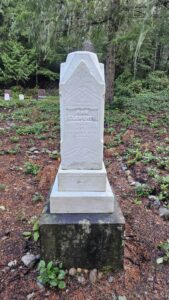
One of the largest and ornately carved headstones in the cemetery belongs to Ann Clements. Her stone reads: 

In loving remembrance of Ann Clements. 

Died July 19, 1880. Aged 42 yrs.

A loving one from us is gone 

A voice we loved is stilled;

A place is vacant in our home 

Which never can be filled.

Ann Donahoe was born in 1838 in Washington county, Maine to Irish immigrants James Donahoe (possibly Donahoe) and Ann (unknown maiden name) .She grew up with her parents on their own farm and had three siblings. Around 1864, Ann married John Clements in Maine. John, Ann, and their daughter Anne moved to the Washington Territory before 1870.  In the 1870 census, John and Ann are recorded as living in Quilcene, Jefferson County, Washington with their two eldest children where John worked as a lumberman. By 1880, he was working as a farmer in Docewallups just across the Hood Canal from Seabeck.  Ann and John eventually had a total of four children: Anne E (1864), John (1870), Lucy R. (1872), J. Henry (1876). 

On July 19, 1880 at the age of 42, Ann passed away from unknown causes. While clearing the salal in Seabeck Cemetery, volunteers came across Ann’s simple foot stone with her initials A.C. This stone likely marked her grave until her marble obelisk was finished and delivered to Seabeck Cemetery.


Andrew Cichey, 1864-1936


Headstone GPS Coordinates: 

Birth: 17 November 1864, Prussia, Germany

Death: 29 February 1936, Seabeck, Kitsap County, Washington

Relatives in Seabeck Cemetery: None

American Revolutionary War Patriots*: None


Andrew Cichey was born on November 17, 1864, in Prussia. He immigrated to the United States sometime between 1890 and 1892 and became a naturalized citizen in 1896. A passenger record exists for an Andreas Cichy who arrived in New York City on April 20, 1892, and who was reportedly born around 1861. While this individual may be the same man later known as Andrew Cichey of Seabeck, the discrepancy in birth year means the identification remains uncertain.

Newspaper accounts from Kitsap County later mention Andrew traveling to California to visit relatives, though the identities of these relatives are not currently known. Further research may help clarify his family connections.

By 1900, Andrew was living in Cokedale, Skagit County, Washington, where he worked as a coal miner. Around 1906 he settled in the Crosby–Seabeck area. The 1910 census records him living in Seabeck and working as a farmer. Andrew never married and had no known children. He was closely associated with the Zuber family, for whom he frequently worked, and he appears to have been well regarded within the local community.

Andrew is mentioned repeatedly in the Kitsap County Herald, providing insight into his daily life and relationships. In October 1929, he was reported to be helping Eddie Zuber haul sand for use on the Zuber chicken farm. In August 1930, he was hospitalized in Bremerton after sustaining serious injuries to his hand and arm while working for Mr. Johnson and Mr. Victor Davies. By August 1932, he was again noted in the paper assisting Ed Zuber with haying and returning from a trip to California with Matt Zoffel. In January 1935, Andrew was reported to be staying at the county hospital due to an affliction in his leg, with friends continuing to assist him during his illness.

Andrew’s life came to a violent and tragic end in early 1936. On the morning of February 27, he was assaulted and robbed in his Crosby cabin by a group described in contemporary newspapers as “gypsies.” According to reports, the group—consisting of a man, two or three women, and a child—had gone door-to-door asking for “the bachelor” and specifically identified Andrew by name. They beat him, threatened his life, and stole approximately $70, money he had been saving for a planned trip to California to visit relatives.

Although Andrew was initially described as “not seriously hurt,” he suffered internal injuries. He died two days later, on February 29, 1936. Doctors concluded that his death resulted from internal injuries, likely sustained during the beating and when he fell or was struck as the attackers fled in their car.

The crime received widespread coverage. Multiple suspects were detained in Portland, Oregon, and authorities attempted to identify members of the group responsible, but no definitive identification was made. As late as 1938, newspapers reported that a suspect believed to be involved in Andrew’s death remained at large.

Andrew was buried in Seabeck Cemetery near the Zuber family plot. For many years, his grave was unmarked. A headstone was later placed to mark his burial site; however, the inscription states that Andrew was a “Spanish-American War veteran.” Available records do not support this claim. Both the 1920 and 1930 census explicitly record that Andrew was not a veteran, and no military service records have been found under any variation of his name in Fold3 or National Archives databases. His death certificate also makes no mention of military service. It is possible that the veteran designation was based on secondhand information provided years later, but in the absence of documentary evidence, it is highly unlikely that Andrew Cichey served in the U.S. military.


Thomas Henry Butcher, 1839 – 1883


Headstone GPS Coordinates: Location in the cemetery is unknown

Birth: 1839, England

Death: 21 April 1883, Seabeck, Kitsap County, Washington

Relatives in Seabeck Cemetery: Thomas Butcher (infant)

American Revolutionary War Patriots*: None


Thomas Henry Butcher was born around 1839 in England. Little is currently known about his parents or early life. Sometime between his birth and his marriage in 1862, he immigrated to Victoria, British Columbia, where he met Christina Veitch. Christina had emigrated from Scotland as a child with her parents; her father was an early employee of the Hudson’s Bay Company in Victoria.

Thomas was twenty-three and Christina only sixteen when they married in 1862. The couple initially settled in Victoria, where their first two children were born: Jane in 1864 and Isabella in 1868.

Later in 1868, the family moved south into the Washington Territory and settled in Seabeck. There, their family continued to grow with the birth of a son, Fred, in 1869, followed by three daughters: Aimee (1872), May (1874), and Grace, known as “Bessie,” in 1878.

Thomas supported his growing family through skilled labor. In 1870 he worked as a blacksmith, and from 1871 to 1876 he was employed at the Seabeck Mill, earning $85 per month. Despite this stability, the years that followed brought increasing hardship. According to historian Fred Just’s notes, Thomas and Christina had another son in 1879, whom they named Thomas; the child lived only one month and was buried in Seabeck Cemetery.

By that same year, Thomas’s mental health had deteriorated significantly. On June 9, 1879, he was committed to the Territorial Insane Asylum in Steilacoom, an event recorded in Jacob Hauptly’s diary:

“Mr. Thomas H. Butcher was sent off this morning to the Territorial Insane Asylum.”

The 1880 census shows Christina living in Port Orchard with her children, where she appears to have managed a boarding house. Listed as head of household, she lived with five of her children, a servant, five white men employed as loggers, sailors, or laborers, and three Chinese laborers. Christina was recorded as a widow who “kept house,” though Thomas was still living at the asylum.

In 1883, Thomas returned to Seabeck to rejoin his family, but his health was severely compromised. He died in April of that year. Jacob Hauptly recorded his death and the community’s response:

 “April 21, 1883: Mr. Thos. Butcher died this morn. I went around with subscription paper and raised about $150 for the Butcher Family. Funeral of butcher evening of 22nd at 5:30 o’clock. Craig read a prayer. Large turnout. A little sprinkle while at grave.”
The following day, Hauptly noted that the total collected for the family amounted to $184.25.

After Thomas’s death, Christina and her children remained in Seabeck for several more years before eventually relocating to Port Townsend.

Neither Thomas Butcher nor his infant son has a surviving grave marker, and their exact burial locations within Seabeck Cemetery are unknown.


Thomas Butcher, 1879-1879


Headstone GPS Coordinates: 

Birth: 1879, Seabeck, Kitsap County, Washington

Death: 1879, Seabeck, Kitsap County, Washington

Relatives in Seabeck Cemetery: Thomas Henry Butcher

American Revolutionary War Patriots*: None


Thomas Butcher was born in 1879 in Seabeck, Washington Territory, the youngest child of Thomas Henry Butcher and Christina (Veitch) Butcher. 

Thomas’s parents were long-time residents of Seabeck. His father, an English immigrant born around 1839, had worked as a blacksmith and later as a mill laborer at the Seabeck Mill, while his mother, Christina Veitch, had come to British Columbia from Scotland as a child with her family. By 1879, Thomas and Christina were raising a large family that included older siblings Jane, Isabella, Fred, Aimee, May, and Grace, known as “Bessie.”

Infant Thomas lived only one month. According to notes later compiled by historian Fred Just, the child’s brief life ended in 1879, and he was buried in Seabeck Cemetery. No surviving marker identifies his grave, and the precise location of his burial is unknown.

His death coincided with a rapid deterioration in his father’s mental health. On June 9, 1879, shortly after the infant’s death, Thomas Henry Butcher was committed to the Territorial Insane Asylum in Steilacoom, as recorded in Jacob Hauptly’s diary. The loss of the child and the institutionalization of his father marked a turning point for the family.


Hiram Bryant, 1823-1869


Headstone GPS Coordinates: Location in the cemetery is unknown

Birth: 1823, unknown location

Death: 26 January 1869, Seabeck, Kitsap County, Washington

Relatives in Seabeck Cemetery: None known

American Revolutionary War Patriots*: Unknown


While there are some stones still standing today, many of the graves in Seabeck cemetery are without a marker. Many of the graves were once marked with cedar slabs that stood about 3 feet tall with deeply carved letters that spelled out the name, date of death, and possibly a bit more information about where the buried person was from and how he or she died. All of the cedar markers have either rotted away or have been taken over the years, except one that is currently hanging in the Seabeck Conference Center. This marker belonged to a man named Hiram Bryant. 

Hiram Bryant’s marker reads “Sacred to the Memory of Hiram Bryant aged about 43 years who was killed in a dispute on the 26th day of January 1869.”

A newspaper article from the Seattle Intelligencer dated February 1, 1869 described the event of Hiram Bryant’s death. This excerpt is taken from Fredi Perry’s book ‘Seabeck: Tide’s Out. Table’s Set.’

“On Jan 26, 1869, a couple of local drunks were whooping it up at Seabeck’s US Hotel, run by William Warin. George Bryant ordered a drink and threw down a 50 cent piece. Sitting next to him was Hiram Bryant,no relation, who picked up the coin and put it in his pocket. Words passed between them and Hiram choked and struck George. George seized a tumbler and threw it at Hiram. As it broke, a shard struck Hiram’s jugular vein and he bled to death on the spot.”

Hiram would have been born in 1823 according to the information on his marker. Unfortunately, no other information can be found about Hiram. There were other Bryant’s in Seabeck, but none of them seem to be of any relation. Hiram’s name lives on because his cedar marker was preserved by the Seabeck Conference Center where visitors can go view his marker and wonder about who he was.


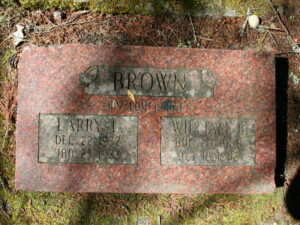
William Benjamin Brown, 1908-1943

Headstone GPS Coordinates: 

Birth: 20 August 1908, Squaw Valley, Okanogan County, Washington

Death: 18 October 1943, Port Orchard, Kitsap County, Washington

Relatives in Seabeck Cemetery: Larry Roy Brown

American Revolutionary War Patriots*: Thomas C. Pasley (Virginia) DAR #A134095

Disclaimer: These lines have not been officially proven by NSDAR standards.


William Benjamin Brown was born on August 20, 1908, in Squaw Valley, Washington, a rural community nestled in the rugged hills of Okanogan County. He was the son of William R. Brown, a man born in Arkansas, and Rose Myrtle Pasley, who came from Idaho. His earliest years unfolded against the backdrop of a frontier-like environment. Okanogan County, sparsely populated at the time, attracted homesteaders, ranchers, and orchardists who carved out a living in the challenging terrain of north-central Washington.

The 1910 census shows two-year-old William listed with his parents, his older brother Chester, and a young woman named Hazel Pasley. Hazel’s exact relationship to the family is uncertain—she may have been Rose Myrtle’s younger sister or perhaps her daughter from an earlier relationship.

By 1920, the Browns had moved about 100 miles south into Methow Valley, another fertile stretch of land in Okanogan County, well known for its orchards and farming potential. At this time, William was eleven years old, living with his parents, Chester, and his younger sister Eunice. The move was typical of families in the early 20th century West, following opportunities for land, farm labor, or seasonal work in orchards.

As William came of age, he likely began contributing to the family’s livelihood. In the 1930 census, a “B.W. Brown” appears in Methow Valley, age twenty-one, listed as a laborer in an orchard. Okanogan County’s orchards offered steady, if physically demanding, employment for young men in the region.

The next year on September 29, 1931, William married Martha C. Neyhart in Okanogan. Martha was the daughter of Ralph and Olive Neyhart of Skagit County, a region of western Washington known for its farmland. She had grown up surrounded by her extended family, and the marriage joined together two families rooted in different parts of the state.

Their joy as a young couple was soon tempered by tragedy. Their first child, Larry Roy Brown, was born on December 22, 1932, but lived only one month. He died on January 23, 1933, from bronchial pneumonia—a common but often fatal illness. His death certificate records his burial at Crosby, Washington, with Martha’s mother, Olive Neyhart, listed as the informant. Family ties suggest Olive may have encouraged the burial there, near her own family in Seabeck. Olive herself was living in Crosby by the mid-1930s, sharing a household with her brother Larry Selby, and other Selby relatives had been buried in Seabeck years earlier.

William and Martha persevered after their loss. By April 1940, the census listed them once again in Okanogan County, in the Methow Valley area. William—recorded this time as “Ben”—was thirty-one, Martha twenty-five, and they had a five-year-old son, R. Richard. William was working steadily, and later that year he completed his mandated World War II draft registration card in Twisp, Washington, listing his occupation with the Department of Highways. This work reflected a shift in rural employment during the Depression years, when government programs and state projects offered stability that farm and orchard work could not always provide. Although registered, William was never called to serve in the military. At that stage of WWII, draft boards generally gave preference to younger, unmarried men, sparing older husbands and fathers like William from conscription.

In 1943, however, the Browns’ lives were altered again. That October, William and his family had moved west to Waterman, near Port Orchard in Kitsap County, where William found work clearing timber and continuing his employment with the state highway department. On October 18, he was suddenly stricken with a heart attack while working near his home. Despite the efforts of his wife and a neighbor who found him, William died at just thirty-five years old. His passing was reported in the Kitsap Sun

“William Benjamin Brown, 35, was found dead last evening near his Waterman home by his wife and a neighbor woman. He was clearing timber and was apparently stricken with a heart attack, dying shortly afterwards. He was born August 20, 1908, in Squaw Creek, Wash., and came to Waterman eight months ago with his wife and son. The deceased was employed as a laborer on the state highway department near Port Orchard.”

Martha remarried not long after William’s death and would marry at least once more before her own passing in 1980.