Infant Girl Nelson, (1894-1894)

Headstone GPS Coordinates: 

Birth: 12 April 1894, Crosby, Kitsap County, Washington

Death: 12 April 1894, Crosby, Kitsap County, Washington

Relatives in Seabeck Cemetery: Andrew Nelson, Malina Nelson, Infant Girl Nelson, Bertha Nelson

American Revolutionary War Patriots*: None

An infant daughter of Malina and Anders (Andrew) Nelson was born on April 12, 1894, in Crosby, Kitsap County, Washington. She was the eleventh child in a large Norwegian immigrant family that had settled near Dyes Inlet in Silverdale. Her parents had journeyed from Sogn og Fjordane, Norway, to America in 1888, establishing a farm and building a new life in the Pacific Northwest.

Her birth came during a difficult season for the Nelson family. On that same day, April 12, 1894, her mother, Malina, died as a result of childbirth complications. The infant did not survive the delivery. She lived only moments, never appearing in census records or other official documents, and her given name—if one was chosen—has not been preserved in surviving records.

She was buried in Seabeck Cemetery beside her mother. Malina’s headstone reads:

“Malina Nelson: Beloved wife of Andrew Nelson, born in Norway July 3, 1853. Died April 12, 1894. At Rest.”

In recent years, while clearing brush and debris around Malina’s grave, volunteers discovered the base of a small, broken headstone nearby. Based on its size and style, it is believed to have belonged to this infant girl or possibly her sister Bertha who died in 1897. 


Bertha Nelson, (1890-1897)

Headstone GPS Coordinates: Burial location unknown. 

Birth: 1890 Kitsap County, Washington

Death: 12 November 1897, Issaquah, King County, Washington

Relatives in Seabeck Cemetery: Andrew Nelson, Malina Nelson, Infant Girl Nelson, Bertha Nelson, Nils Myhre

American Revolutionary War Patriots*: None

Bertha Nelson was born in 1890 in Kitsap County, Washington, the daughter of Norwegian immigrants Anders (Andrew) and Malina Nelson. She grew up on her family’s farm near Dyes Inlet in Silverdale, where her father cultivated the land and raised poultry. Bertha was one of eleven children in a large pioneer household shaped by hard work, faith, and both joy and sorrow.

When Bertha was just four years old, tragedy first touched her young life. On April 12, 1894, her mother died while giving birth to her eleventh child. The infant did not survive. Bertha and her siblings were thereafter raised by their father on the family homestead.

In November 1897, tragedy struck again—this time claiming Bertha’s life. While traveling with her father, who at times worked in the coal mines of Issaquah, Bertha fell from a bridge into the river below and drowned on November 12, 1897. She was only seven years old.

Her death was published in the Mason County Journal, Friday, 26 November 1897.

We regret to learn of the accidental death by drowning of a daughter of Mr. Nelson who lives back of Seabeck, near Crosby, on the 12th . The body was not recovered until two days afterwards and was brought home on the 16th for burial. She was about seven years old.

Bertha was laid to rest in Seabeck Cemetery. While cleaning near her mother Malinda’s grave, a small, broken,pre-1900 style headstone was found that could have belonged to her or possibly her infant sibling who died with her mother. 


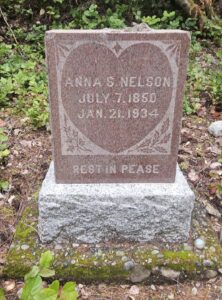
Anna Sofie Nelson née Martinusdatter Einen, (1850-1934)

Headstone GPS Coordinates:

Birth: 7 July 1850, Askvoll, Sogn og Fjordane, Norway

Death: 21 January 1934, Silverdale, Kitsap County, Washington

Relatives in Seabeck Cemetery: Andrew Nelson

American Revolutionary War Patriots*: None

Anna Sofie Martinusdatter Einen Nelson was born July 7, 1850, in Askvoll, Sogn og Fjordane, Norway. She immigrated to the United States on May 26, 1887, sailing from Bergen with her brother Hans. Settling in Seattle, Anna worked as a domestic servant, building an independent life in a new country.

On July 7, 1899, she married widower Anders (Andrew) Nelson in Seattle. She then moved to his farm in Kitsap County near Silverdale, where she became part of a large Norwegian-American farming community. There, Anna helped manage the household and farm operations alongside her husband, contributing to the success and stability of their homestead.

By 1900, Anna was living on the Nelson farm with Anders and several of his children. She remained on the farm for decades, and according to the 1920 Federal Census, she was listed as a farmer and a naturalized citizen. Even after Anders’s death in 1917, Anna continued living on and working the property. Her sister, Christine Einen, later lived with her.

Anna died of pneumonia on January 21, 1934, at the age of eighty-three. She was buried in Seabeck Cemetery.

Her passing was noted in two local newspapers.

The Kitsap County Herald (January 26, 1934) reported:

“Anna Nilson, a resident of Silverdale for the past twenty-five years, died Sunday night, at the age of 83 years. She had made her home with her sister, Christine Einer. She also leaves a brother in California and some sisters and a brother in Norway. The funeral was held in the Silverdale Gospel Tabernacle on Thursday.”

The Bremerton News Searchlight (January 23, 1934) wrote:

“Anna Nilson, Well Known Silverdale Resident, is Dead
A resident of Silverdale for 25 Years, Aged Woman Leaves Many Friends to Mourn.

Anna Nilson, 83-year-old pioneer Silverdale resident of 25 years, died Sunday night at 9:30 at her home where she had been living with her sister, Christina Einer. She was born in Norway July 7, 1850, and leaves besides her sister here a brother, Hans, in California and three sisters and one brother in Norway.

Funeral services will be held Thursday afternoon at 1 o’clock at the Silverdale Gospel Tabernacle with Mrs. L. A. Engler officiating. Burial will be in Seabeck cemetery. Steltz and Son are in charge of the remains.”

Anna’s life reflects the experience of many immigrant women of her era—crossing the Atlantic as an adult, establishing herself through work, helping sustain a farming household, and becoming part of a close-knit pioneer community in Kitsap County.


Andrew Nelson, (1849-1917)

Headstone GPS Coordinates: Burial location unknown.

Birth: 12 February 1849, Innvik, Sogn og Fjordane, Norway

Death: 19 March 1917, Silverdale, Kitsap County, Washington

Relatives in Seabeck Cemetery: Nils P. Myhre, Malina Nelson née Jakobsdatter, Anna M. Nelson née Einen, Infant Girl Nelson, Bertha Nelson

American Revolutionary War Patriots*: None


Anders (Andrew) Nelson was born on February 12, 1849, in Innvik, Sogn og Fjordane, Norway, to Niels Pedersen Muri (Myhre) and Johanne Davidsdatter Nelson. After the early death of his mother, he received a religious education and served as an assistant pastor at the Maloy Church.

On October 26, 1873, Anders married Malina Jakobsdatter in Selje, Sogn og Fjordane, Norway. The couple remained in Selje, where they welcomed eight children: Anna (1874), Lena (1875), Ingeborg (1878), Jakob (1880), Jennie (1881), Diana (1883), Nels (1885), and Hans (1888).

In June 1888, Anders immigrated to America with his family, accompanied by his father, Niels, and stepmother, Brithe Myhre. Due to limited records, it is unclear whether his three youngest sons—Jakob, Nels, and Hans—survived the journey or died in Norway, as they disappear from the historical record after their baptisms.

The family settled in Crosby, Kitsap County, Washington, where Anders established himself as a farmer. Two additional children were born in Washington: Bertha (1890) and Albert Clarence (1892). In 1892, Anders purchased seven 160-acre parcels of land in the Willamette Meridian section of Kitsap County. In 1895, he received two additional 160-acre parcels through a federal homestead patent. His farm was located east of the Meridian near the tip of Dyes Inlet in Silverdale. There, he farmed the land and raised poultry alongside his half-brothers, Paul and Peter Myhre.

Tragedy struck on April 12, 1894, when his wife Malina died in childbirth at the age of forty. The infant did not survive. In 1897, while Anders was traveling to work in the coal mines of Issaquah, his young daughter Bertha drowned in a tragic accident while crossing a bridge. Bertha was laid to rest in Seabeck Cemetery.

On July 7, 1899, Anders married Anna M. Einen in Seattle. By the 1900 census, he was living on his Kitsap County farm with his wife and sons Nels and Albert. He became part owner of the  Schneebeck Saw Mill in Silverdale. Over the years, some of his children married and settled elsewhere, while others remained nearby.

Anders became a naturalized American citizen on June 29, 1906. In 1910, he continued farming in Kitsap County, with several family members residing in his household at various times.

Anders Nelson died on March 19, 1917, at his home in Silverdale, Kitsap County, Washington, at the age of sixty-eight from heart failure. His obituary was published in the Kitsap County Herald on March 23, 1917:

Mr. Andrew [Nelson], one of most esteemed citizens, neighbor, and friend, passed away at the family home March 19, 1917, at 3:20 a.m. Mr. Nelson had been ill a long time, suffering from an affliction of the heart. During the past week, all of his children were summoned to come home and nearly all were present at his departure. Mr. Nelson was born in Olden, Norway, Feb. 12, 1849. In the year 1873, he married Miss Malina Jocobson, with whom he had eleven children. Mrs. Nelson died April 12, 1894. July 3, 1899, Mr. Nelson remarried. Mr. Nelson leaves a widow and seven children. Four daughters, Mrs. Lean La Clair of Oakland, California, Mrs. Jennie Einen of Patterson, California, Inga Davich of Aberdeen, Wash., Mrs. Diana Davich of Redmond, Wash., and three sons, Jack, Nels and Albert, all of Silverdale. Also, one sister, Mrs. R. O. Qualheim of Bremerton, and two brothers, Paul and Peter Myhre, residing in Silverdale.

Funeral services take place March 22. Interment at Seabeck.

Andrew was buried in Seabeck Cemetery, though today no marker identifies his grave.

 

Nils Pederson Teigen (Muri) Myhre, (1829-1893)

Headstone GPS Coordinates: 

Birth: 05 June 1829, in Innvik, Sogn og Fjordane, Norway

Death: 1893 , poss. Crosby, Kitsap County, Washington

Relatives in Seabeck Cemetery: Brithe P. (Pedersdatter Aasene) Myhre

American Revolutionary War Patriots*: None

Nils Pederson Teigen (Muri) Myhre was born on June 5, 1829, in Innvik, Sogn og Fjordane, Norway, and was baptized on June 14 of that year. He was the second of eight children born to Peder Michelsen (Mikkelsen) Teigen and Sara Andersdatter Scharsteen. Raised in the rural farming community of Innvik, Nils grew up in a tradition deeply rooted in land, family, and faith.

It is believed that Nils first married Johanne Davidsdotter Nelson, though no marriage record has been found. In 1849, their son, Anders Nilson Muir, was born on the Muri farm in Innvik. Little else is known about Johanne, and it remains unclear whether she died or the couple separated.

On May 17, 1854, Nils married Berte Marie Larsdotter in Selje Parish, Nordfjord Prosti, Norway. Their happiness was short-lived. On July 6, 1855, at the Myhre farm in Selje Parish, Berte and their infant daughter both died in childbirth—a devastating loss for the young farmer.

Less than a year later, on June 21, 1856, Nils married his third wife, Brithe Malena Pedersdatter Aasene, in Davik Parish. Brithe had been born on January 8, 1831, in Davik Indre to Peder Jorgensen Aasene and Lizbeth Lasesdatter Skord. She became Nils’s partner in rebuilding family life after tragedy.

Together, Nils and Brithe settled on the Myhre farm in Selje Parish, where they raised seven children: Bertine Serene, Sise Patrine, Peder Martinus (Peter), Johan, Johanne Samuline, Paul Andreas, and Lars Mikal. Like many families of their time, they endured great hardship, losing several children in infancy or childhood. Only Peter, Johanne, and Paul survived to adulthood.

In 1888, at the age of 58, Nils made the bold decision to leave Norway in search of new opportunity. On June 1, he and Brithe departed Bergen, emigrating to America with his son Anders Nelson and family. (Under the traditional Norwegian patronymic naming system, surnames were derived from the father’s given name; thus, “Nelson” means “son of Nils.”) They arrived in America on June 7, 1888.

By 1891, Nils and Brithe were living in Crosby, Washington, with the Qualheim family. Nils received two federal land grants of 160 acres each, located just north of Dyes Inlet in what is now Silverdale. There he established a new homestead, continuing the farming life he had known since childhood in Norway.

Nils P. Myhre died in 1893 at the age of 64. His wife, Brithe, died the following year in 1894. They are buried together at Seabeck Cemetery, their causes of death unknown. Their headstone reads:

“Nils P. Myhre 1829–1893 — Brithe P. Myhre 1830–1894 — At Rest.”

Nils’s legacy endured through his children. All three surviving children eventually settled in Kitsap County. His youngest son, Paul, continued farming and raising chickens on the family land. In 1909, Paul and Peter opened a sawmill along Clear Creek. Today, a major road in Silverdale bears the Myhre name—a lasting reminder of Nils’s determination, perseverance, and the enduring mark he left on the community.

Descendants of the Myhre family clarified that the name is pronounced like “Meyer.”


Brithe P. Myhre née Pedersdatter Aasene, 1831-1894

Headstone GPS Coordinates: 

Birth: 8 January 1831, Davik Indre, Davik, Sogn og Fjordane, Norway,

Death: 1894, poss. Crosby, Kitsap County, Washington

Relatives in Seabeck Cemetery: Nils P. Myhre

American Revolutionary War Patriots*: None

Brithe Pedersdatter Aasene was born on January 8, 1831, in Davik Indre, Davik, Sogn og Fjordane, Norway, and was baptized on January 16, 1831. She was the eldest of four children born to Peder Jorgensen Aasene and Lizbeth Lasesdatter Skord, who spent their entire lives in the Davik area. Brithe was named in honor of both of her grandmothers, Brithe Josepsdotter Aasene and Brithe Johannesdatter Kirkejde, reflecting a cherished family tradition.

On June 21, 1856, Brithe married Niles Pederson Tejgen (Muri) Myhre in Davik Parish, Nordfjord Prosti, Norway. Niles had been born on June 5, 1829, in Innvik, Sogn og Fjordane, to Peder Michelsen (Mikkelsen) Teigen and Sara Andersdatter Scharsteen. He was the second of eight children. Prior to his marriage to Brithe, Niles is believed to have been married to Johanne Davidsdotter Nelson, though no marriage record has been found. Their son, Anders Nilson Muir, was born in 1849 on the Muri farm in Innvik. Niles later married Berte Marie Larsdotter on May 17, 1854, in Selje Parish, Nordfjord Prosti. Tragically, Berte and their infant daughter both died in childbirth on July 6, 1855, at the Myhre farm in Selje Parish.

When Brithe married Niles, she became both wife and stepmother, beginning a life marked by resilience and devotion to family. The couple settled on the Myhre farm in Selje Parish, where they raised seven children: Bertine Serene, Sise Patrine, Peder Martinus, Johan, Johanne Samuline, Paul Andreas, and Lars Mikal. Like many families of the era, they endured heartbreaking loss; only three of their children—Peter (Peder Martinus), Johanne, and Paul—survived to adulthood.

In 1888, at the age of 57, Brithe made the life-changing decision to leave her homeland. On June 1, she and Niles departed Bergen, Norway, emigrating to America with Niles’s son Anders Nelson and his family. (In Norwegian naming tradition, surnames were typically patronymic—based on the father’s given name. Thus, “Nelson” means “son of Nels.”) They arrived in America on June 7, 1888, seeking new opportunity and stability after decades of farming and family life in Norway.

By 1891, Brithe and Niles were living in Crosby, Washington, with the Qualheim family. Niles received two federal land grants of 160 acres each, located just north of Dyes Inlet in what is now Silverdale, Washington. 

Niles died in 1893 at the age of 64. Brithe followed the next year, passing away in 1894. The causes of their deaths are unknown. They are buried together at Seabeck Cemetery. Their shared headstone reads:

“Nils P. Myhre 1829–1893 — Brithe P. Myhre 1830–1894 — At Rest.”

All three of Brithe’s surviving children eventually emigrated to Kitsap County. Her youngest son, Paul, continued farming and raising chickens on his father’s land. In 1909, Paul and Peter opened a sawmill along Clear Creek. Today, a major road in Silverdale bears the Myhre family name—a lasting tribute to the courage and determination of Brithe and her family, whose journey from rural Norway helped shape the community for generations to come.

Descendants of the Myhre family clarified that the name is pronounced like “Meyer.”


William Moran, 1836-1909

Headstone GPS Coordinates: 

Birth: 15 November 1836, Williamstown, Glengarry County, Ontario, Canada

Death: 27 November 1909, Crosby, Kitsap County, Washington

Relatives in Seabeck Cemetery: None.

American Revolutionary War Patriots*: None

William Moran entered the world on November 15, 1836 in Williamstown, a rural settlement in Glengarry County, Ontario. He was the son of William and Ann Moran, both Irish immigrants who had joined the great wave of migration that followed decades of economic hardship, agrarian unrest, and the lingering aftermath of the Irish famine years. In Canada, the family carved out a life on the developing frontier of Upper Canada, raising six children, with William the fourth among them.

By the time of the 1851 Census of Leeds, in what was then called Canada West, the Morans appeared as “inmates” and “laborers,” terms used at the time to describe families who lived and worked on another household’s property—often farm hands or resident laborers dependent on seasonal employment. Such listings reflected the precarious economic position many immigrant families occupied during this period of rapid settlement and agricultural expansion.

In 1856, as thousands of young Canadians sought opportunity in the growing United States, William joined the migration and crossed the border. By 1860 he was living in a boarding house in Saginaw, Michigan, a booming lumber town at the heart of the Great Lakes timber trade. Like many men of his generation, he found work as a laborer, contributing to an industry that powered much of Michigan’s early economic growth.

A decade later, in 1870, William had moved even farther west to Seabeck in Washington Territory. The Pacific Northwest was then undergoing its own lumber-driven transformation, and Seabeck was one of the region’s busiest mill towns. Here, William worked as a lumberman, part of the rugged workforce that fueled the expansion of American settlement on Puget Sound.

In 1873, William returned to his native Glengarry County to marry Catherine “Kate” McDonald. Shortly after the wedding, the couple resettled in the United States, most likely in Bay City, Michigan—another major center of the lumber trade—where William again worked as a laborer. Their three children were born there: Mary Ann in 1878, Daniel William in 1880, and John Robert in 1882. Amid this period of family life, William formally began the process of becoming a U.S. citizen, filing his declaration of intent in Bay County on April 14, 1884.

The Morans joined the great wave of settlers heading to the Pacific Northwest in the late 1880s, arriving in Seattle in 1889, the same year Washington achieved statehood. They remained in the growing city at least through the 1900 federal census, and in 1890 William completed his naturalization, becoming a U.S. citizen in Seattle.

After 1900, William returned to Kitsap County, where he had worked decades earlier. In the autumn of 1909, suffering the effects of age and a recently broken leg, he died at the age of seventy-two on November 27th in Crosby. His official cause of death was recorded as “softening of the brain,” with the injury and “senility” listed as contributing factors—a common phrasing in early twentieth-century medical records.

William Moran was laid to rest in the Seabeck Cemetery, not far from the mills and forests where he had spent some of the most defining years of his working life.   In recent years, one of his descendants placed a marker at his grave, ensuring that his memory would be preserved for future generations.


Sarah Moran (née Cartwright), (1857-1882)

Headstone GPS Coordinates: Burial location unknown.

Birth: 05 February 1857, Worcestershire, England.

Death: 18 July 1882, Bangor, Kitsap County, Washington

Relatives in Seabeck Cemetery: Infant Girl Moran

American Revolutionary War Patriots*: None


Sarah Cartwright was born on February 5, 1857, in Worcestershire, England. Little is known about her early life: her parents’ names remain unrecorded, and no details survive regarding how, when, or with whom she emigrated from England. By the mid-1870s, however, Sarah had made her way to the Washington Territory—likely to Union City (now Union)—where she worked as a schoolteacher. It was there that she met Thomas “Tommy” Moran, a young lumberman whose work placed him squarely within the booming timber economy that was transforming the Pacific Northwest at the time.

The couple traveled to Victoria, British Columbia, where they were married on May 31, 1877. They established their first home in the old Webb House, originally built by Thomas Webb near the river north of the present bridge, in what was then a large orchard. Their first two sons were born on the farm: John William “Pat” Moran on April 2, 1878, and Thomas Cartwright Moran on August 21,1879.

Sometime during 1880, the Morans relocated to the small settlement of Three Spits in Kitsap County, north of Seabeck on Hood Canal.  [Special note: Three Spits was located on the site of present-day Bangor Naval Base, near Silverdale, WA.]  Like many new communities along Puget Sound, Three Spits grew around the logging industry, and Tommy continued his work as a lumberman. Their third son, Arthur Garfield Moran, was born there on November 25, 1880. Travel between Union City and Three Spits at that time was difficult. Hood Canal separated the two settlements, and although the distance by water was only about 15–25 miles, the overland route was far longer and obstructed by dense forests, steep terrain, and limited roadways. In the early territorial era, maritime travel was the lifeline of the region, and residents relied on sailboats, steamers, and canoes to move people and goods throughout Puget Sound.

Tragedy struck on July 18, 1882, when Sarah died giving birth to a daughter who also did not survive. Her body, and presumably her infant daughter’s body, were taken by sloop from Three Spits to Seabeck the following day. Sarah and her daughter were buried in Seabeck Cemetery at 10:30 a.m. on July 20, 1882 by Jacob Hauptly, who was the cemetery’s caretaker.

Soon after Sarah’s death, her husband Thomas moved to Shelton, where he settled, remarried, and raised his family. Thomas died on January 10, 1915, and was buried in Shelton Memorial Park.

What is unusual is that there is a headstone next to Thomas’s for Sarah that reads: “In Remembrance Of: Sarah, wife of Thomas Moran, born Feb. 5, 1857, died July 18, 1882.” The SCRP team presumed that Sarah’s remains may have been exhumed from Seabeck at some point and reinterred in Shelton so her family could visit her. However, Shelton Memorial’s records contain no evidence that Sarah was ever interred there.

The plot in which Thomas is buried was not purchased until February 5, 1911, nearly three decades after Sarah’s death. The first burial in that plot occurred on February 15, 1911, and was an infant grandchild born to their son, John William “Pat” Moran, and his wife, Ella.

It remains a mystery whether Sarah’s marker was originally placed at her grave in Seabeck and later moved to Shelton to be near Thomas, or whether it was created later as a memorial tribute rather than as a marker for an actual burial.


Infant Girl Moran (1882-1882)

Headstone GPS Coordinates: Burial location unknown.

Birth: 18 July 1882, Three Spits (Bangor), Kitsap County, Washington

Death: 18 July 1882,Three Spits (Bangor), Kitsap County, Washington

Relatives in Seabeck Cemetery: Sarah Moran

American Revolutionary War Patriots*: None


On July 18, 1882, in the remote logging settlement of Three Spits in Kitsap County (near present-day Naval Base Kitsap – Bangor), an infant girl Moran was born into a rugged and isolated frontier world—and died the same day.

She was the fourth child of Sarah Cartwright Moran and Thomas “Tommy” Moran, a lumberman whose work tied the family to the booming timber economy of Washington Territory. Her mother, Sarah, had been born on February 5, 1857, in Worcestershire, England, and had come to the Pacific Northwest as a young woman, working as a schoolteacher in Union City (now Union). Sarah and Thomas were married on May 31, 1877, in Victoria before settling along Hood Canal, where three sons were born: John William “Pat” (1878), Thomas Cartwright (1879), and Arthur Garfield (1880).

By the summer of 1882, the Morans were living at Three Spits, a small logging community north of Seabeck. Travel between settlements depended almost entirely on water routes across Hood Canal, as dense forests and primitive roads made overland journeys difficult and slow.

The infant girl’s birth proved tragic. Her mother died delivering her, and the baby did not survive. The following day, July 19, their bodies were carried by sloop across Hood Canal to Seabeck. On the morning of July 20, 1882, at 10:30 a.m., both were buried in Seabeck Cemetery by the caretaker, Jacob Hauptly.

Though unnamed in surviving records, the infant girl’s brief life was bound to her mother’s in both birth and burial. Her father later moved to Shelton, remarried, and continued raising the family. He died on January 10, 1915, and was buried in Shelton Memorial Park.

A curious mystery remains. Beside Thomas’s grave in Shelton stands a headstone for Sarah, inscribed with her birth and death dates. Yet cemetery records contain no evidence that Sarah—or her infant daughter—were ever reinterred there. The burial plot was not even purchased until 1911, nearly thirty years after their deaths, when an infant grandchild was laid to rest.

Whether Sarah’s marker was moved from Seabeck, or created later as a memorial tribute, remains unknown. As for the infant girl Moran, her life left no records beyond that single tragic day in July 1882—her story preserved only through the circumstances of her birth, death, and shared grave beside her mother.


Frank Milanoski, (1906-1907)

Headstone GPS Coordinates: Burial location unknown.

Birth: 23 October 1906, Seabeck, Kitsap County, Washington

Death: 8 January 1907, Seabeck, Kitsap County, Washington

Relatives in Seabeck Cemetery: None.

American Revolutionary War Patriots*: None


In the “Register of Deaths in Kitsap,” it is recorded that an infant named Frank Milanoski passed away from “convulsions” on January 8, 1907. His date of birth was listed as October 23, 1906, which means he was 77 days old when he died. The family’s residence was noted as Seabeck. Given the prevalence of post-neonatal deaths (infants older than 28 days) from water and foodborne diseases in that era, it is highly likely that Baby Frank succumbed to one of the many infectious illnesses that tragically claimed the lives of countless babies before the advent of modern public health measures like water sanitation and pasteurization.

It is highly probable that Baby Frank was born in the home of his maternal grandparents, Bernard and Martha Kaiser, as they were living in Seabeck at the time. His grandfather, Bernard, was working as a merchant in a retail store, suggesting the Milanoskis may have been residing with Mary’s family when their second born son was born and died. 

Baby Frank was likely buried in Seabeck Cemetery. It’s unknown where in the cemetery he is buried. 

Baby Frank’s parents, Frank Sr. and Mary, carried a history of migration and change. Frank Milanoski Sr. was born in St. Paul, Minnesota, in 1885, into a Polish immigrant family. He married Mary Kaiser in Minnesota in 1903. Mary, born in either Poland or Germany, was part of a family that had also migrated to the United States. Their first son, John, was born in Minnesota in 1904.

Sometime between 1904 and 1906, the young family moved west, settling in Seabeck, following Mary’s parents and siblings who had all moved to the Seattle area.

By the 1910 census, Frank and Mary were living in Seattle, where Frank worked as a motorman alongside his brother, John. Another son, Stanley, was born there in 1912.

Following Stanley’s birth, the Milanoskis returned to St. Paul, Minnesota. Their daughter, Helen, was born there in 1918, and by 1920, Frank Sr. had become a respected St. Paul policeman.

Life was stable and happy until tragedy struck a second time, shattering the family once more. While he was off duty and out driving with his wife and young children, Frank stopped his car to confront a former deputy sheriff for a traffic violation he had witnessed. An altercation erupted, and Frank was struck, fell backward, and suffered a fatal skull fracture on the sidewalk. The former deputy sheriff was arrested and charged with murder, and Frank Sr. is now listed in the United States Officer Down Memorial database.

Distraught and traumatized, Mary quickly moved back to Seattle with her young children to be near her siblings, possibly residing with her older brother, Bernard Kaiser. However, a third and final tragedy would soon follow. Mary Milanoski died in 1928 at the young age of 42 from lobar pneumonia and epilepsy. She was buried in Calvary Cemetery in Seattle. Her younger sons and her daughter were taken care of by her parents who were now residing in Seattle.

Baby Frank’s siblings grew up and lived their lives. Several moved to other states, but they probably wondered about their brother buried in Seabeck, Washington.