William Bell, Abt 1831-1869

Headstone GPS Coordinates: 

Birth: Abt. 1831, location unknown

Death: 17 Jan 1869, Seabeck, Kitsap County, Washington

Relatives in Seabeck Cemetery: None known.

American Revolutionary War Patriots: None known. 

While researching the earliest newspapers from the period when Washington was still a territory, the SCRP team uncovered several articles describing the circumstances surrounding the deaths of William Bell and a man known only by the surname Hamilton. According to these accounts, the two men had been indulging in strong drink before setting out in a canoe to cross Hood Canal to Walker’s timber camp. They never arrived.

A letter published in The Echo and dated February 5, 1869, recounts the incident:

“Seabeck, Jan. 26th, 1868.
It is with painful feelings I record the following: On the evening of the 17th inst., Wm. Bell and —-Hamilton were drowned. The particulars, as near as I can learn, are that about dusk on the day above mentioned, they left this place for Walker’s camp, on the opposite side of the Canal, and it is supposed that when within hearing distance of camp their canoe upset, separating them, as voices were heard at camp in different directions; but as the hallooing soon ceased, and those in the camp thinking it was Indians, no assistance was rendered, and thus they met their untimely death.”

Nine days later, William Bell’s body washed ashore nearly twenty miles away. It was recovered and returned to Seabeck, where he was buried and marked with an inscribed cedar slab.

William Bell’s grave marker is one of only two original cedar markers still known to exist from Seabeck Cemetery. Its inscription reads:

Sacred to the memory of William Bell,
Aged about 38 years,
Drowned, Jan 17, 1869.

To date, the team has been unable to locate additional records detailing William Bell’s life. There is no indication that he had family in Seabeck, suggesting he was likely one of the many hardworking bachelors in the area whose life ended prematurely due to a combination of liquor and poor judgment.

While little is known about William Bell himself, the story of his wooden marker is well documented. The marker remained in the cemetery until July 24, 1971, when it was reported stolen in the Kitsap Sun. Shortly thereafter, an anonymous caller contacted the Kitsap County Sheriff to report seeing the marker “near the old county road shed on Mitchell Road” in Port Orchard. Deputies recovered the marker and returned it to Seabeck.

On August 21, 1977, cemetery caretaker and historian Fred Just donated the cedar marker to the Kitsap History Museum, where it has since been protected from both theft and the elements.

Hamilton’s body was never recovered. Records from the Washington Mill Company for the years 1860–1870 list an employee named J. Hamilton earning $35 per month. Whether this individual was the same man who drowned alongside William Bell—and who may still rest at the bottom of Hood Canal—remains uncertain.


Samuel J. Bassett, 1850-1940    

Headstone GPS Coordinates: 

Birth: 4 April 1850,   Llanelly, Carmarthenshire, Wales   

Death: 23 June 1940, Sedro-Woolley, Skagit County, Washington

Relatives in Seabeck Cemetery: Anna (Evans) Bassett, John Evans

American Revolutionary War Patriots: None

Samuel J. Bassett was born on April 4, 1850, in Llanelly, Carmarthenshire, Wales, United Kingdom, to Samuel Bassett and Elizabeth Hopkins. He was the eldest of six children.

Many families in Llanelly worked in the region’s rich coal mines, and, like his father, Samuel became a coal miner. Around 1871, when he was twenty-one years old, Samuel moved with his parents and siblings to Clydach, Ystradyfodwg, Glamorgan, Wales, where he may have met his future wife, Anna.

Anna J. Evans was born on December 16, 1849, in Llanfyllin, Montgomeryshire, Wales. Her father, John Evans, was a laborer, and her mother was Mary Vaughn.

Samuel and Anna were married in 1874.

In 1877, the couple departed Liverpool, England, aboard the steamer City of Richmond, arriving in New York City on October 1. In the 1880 census, they were living in Palmyra, Portage County, Ohio, where Samuel worked as a coal miner and Anna as a housekeeper. Anna’s father, John Evans, was living next door with her uncle, Wakin Vaughn; both men were employed as coal miners.

Sometime around 1891, the Bassetts moved to Crosby in Kitsap County, Washington. They eventually purchased 160 acres of land just northeast of the Crosby School. In time, Anna’s father, John Evans, came to live with them.

While primarily working his farm, Samuel also became a Baptist minister. He conducted church services in the Crosby Schoolhouse on Sundays and wrote several obituaries for deceased community members that were published in the Kitsap County Herald under the pen name “Brutus.” He was also a member of the Crosby Community Club. In 1895, he was elected Justice of the Peace in Seabeck and served in this role for one year.

By 1910, Samuel was listed as working as a carpenter. On April 10, 1918, his wife Anna died in Seattle, likely while seeking treatment for the lobar pneumonia that claimed her life. She was sixty-seven years old. Her body was brought back across the Sound for burial at Seabeck Cemetery.

The late historian Fred Just recorded the following story in his book Seabeck and the Surrounding Area:

“After his wife died, he [Samuel] tried to ‘spark’ Nancy M. Just. Sam always carried a cane and chewed tobacco which drooled down his chin. She had no interest in him although she was kind to him. One night when visiting her he stayed till after dark, so she asked her grandson Melvin E. Just to walk Mr. Bassett home. Melvin did not like Mr. Bassett. Shortly after leaving, Melvin came back home. When questioned why he was back so quick, he said that Mr. Bassett told him that he could make it on his own so Melvin could go back home. At that time, Mrs. Just’s son Lester had taken out some large stumps so that the garden could be extended. One hole in particular was rather deep and muddy. It was found out later that Melvin had led Mr. Bassett into the hole and left him there to make his own way home. There is no record of Melvin’s punishment.”

Samuel continued to live alone on his farm in Crosby until tragedy struck twice when two of his homes burned down in 1927 and 1928. These incidents were recorded in the Kitsap County Herald (it is worth noting that Samuel himself was known in the paper by the pen name “Brutus”).

Kitsap County Herald, Friday, April 1, 1927:
The Home of Brutus Burns to the Ground

“The house, barn and some other buildings belonging to Rev. S. J. Basset of Crosby burned to the ground Wednesday noon. Mr. Bassett had gone a little ways from home and was doing some work on his place, when he looked up and saw the roof of his house ablaze. He rushed home and made every effort to put out the fire, but it was too far gone. He was alone and had no one to help him. In the excitement, he rescued only a few minor things. About everything he had except the clothes he wore was burned up. He saved a few bedclothes and his radio, easiest to get out, but all the rest went up in smoke. He had $50 in paper money put away, and that burned up with the rest. He had many valuable things, some of which he could not put a price on, as they were much thought of. Mr. Bassett’s health has been quite poor lately, and he had no insurance, so everything is a complete loss. It is a pitiful case. His large number of friends may make some arrangement to help him out, as the people around Crosby have shown a fine spirit before.”

Kitsap County Herald, Friday, July 13, 1928, Seabeck:

“Rev. Bassett lost his little house again by fire a few weeks ago. He lost practically everything he had, among which was a gold watch and other precious heirlooms. The neighbors have helped him to build another small house. The Hite brothers donated part of the lumber.”

Samuel was in his late seventies when these fires occurred. In 1930, he was living as a boarder with the Barricean (Barrieau) family in Crosby. He sold forty acres of his property to Jack Barrieau and his family while continuing to live with them.

In 1933, fire struck once again.

Kitsap County Herald, October 27, 1933, Crosby:

“Mr. S. J. Bassett burned out his last small shack about a couple weeks ago. In the fire he lost his good overcoat and most all of his clothes. This is the third time Mr. Bassett has lost his place of abode by fire in the last five years. One has to be very careful about fire, and when a man gets old, he sure needs someone to watch and care for him, and even then, one can’t always do it. This time Mr. Bassett almost lost his life. It is a constant worry to the folks who care for him. He has caught his clothes on fire so many times with his pipe. We hope in the future that he will be more careful.”

In 1934, Samuel moved to Sunnyvale Home in Port Orchard. By 1935, he was living in Snohomish County. In the 1940 census, taken on April 16, Samuel was listed as a patient at Northern State Hospital. He died a few months later, on June 23, 1940, at the age of ninety.

Samuel’s body was returned to Seabeck Cemetery, where he was buried beside his wife. Neither Samuel’s nor Anna’s grave has a headstone today, but both burial sites are marked on Fred Just’s plot map.

According to available records, Samuel and Anna never had any children. Samuel’s only known relative living in the area was his nephew, John Emlyn Bassett, who resided in Bremerton.

 

Anna (nee Evans) Bassett, 1849-1918


Headstone GPS Coordinates: 

Birth: 16 Dec 1849, Llanfyllin, Montgomeryshire, Wales, United Kingdom

Death: 10 Apr 1918, Seattle, King County, Washington, USA

Relatives in Seabeck Cemetery: Samuel Bassett, John Evans

American Revolutionary War Patriots: None


Samuel J. Bassett was born on April 4, 1850, in Llanelly, Carmarthenshire, Wales, United Kingdom, to Samuel Bassett and Elizabeth Hopkins. He was the eldest of six children.

Many families in Llanelly worked in the region’s rich coal mines, and, like his father, Samuel became a coal miner. Around 1871, when he was twenty-one years old, Samuel moved with his parents and siblings to Clydach, Ystradyfodwg, Glamorgan, Wales, where he may have met his future wife, Anna.

Anna J. Evans was born on December 16, 1849, in Llanfyllin, Montgomeryshire, Wales. Her father, John Evans, was a laborer, and her mother was Mary Vaughn.

Samuel and Anna were married in 1874.

In 1877, the couple departed Liverpool, England, aboard the steamer City of Richmond, arriving in New York City on October 1. In the 1880 census, they were living in Palmyra, Portage County, Ohio, where Samuel worked as a coal miner and Anna as a housekeeper. Anna’s father, John Evans, was living next door with her uncle, Wakin Vaughn; both men were employed as coal miners.

Sometime around 1891, the Bassetts moved to Crosby in Kitsap County, Washington. They eventually purchased 160 acres of land just northeast of the Crosby School. In time, Anna’s father, John Evans, came to live with them.

While primarily working his farm, Samuel also became a Baptist minister. He conducted church services in the Crosby Schoolhouse on Sundays and wrote several obituaries for deceased community members that were published in the Kitsap County Herald under the pen name “Brutus.” He was also a member of the Crosby Community Club. In 1895, he was elected Justice of the Peace in Seabeck and served in this role for one year.

By 1910, Samuel was listed as working as a carpenter. On April 10, 1918, his wife Anna died in Seattle, likely while seeking treatment for the lobar pneumonia that claimed her life. She was sixty-seven years old. Her body was brought back across the Sound for burial at Seabeck Cemetery.

The late historian Fred Just recorded the following story in his book Seabeck and the Surrounding Area:

“After his wife died, he [Samuel] tried to ‘spark’ Nancy M. Just. Sam always carried a cane and chewed tobacco which drooled down his chin. She had no interest in him although she was kind to him. One night when visiting her he stayed till after dark, so she asked her grandson Melvin E. Just to walk Mr. Bassett home. Melvin did not like Mr. Bassett. Shortly after leaving, Melvin came back home. When questioned why he was back so quick, he said that Mr. Bassett told him that he could make it on his own so Melvin could go back home. At that time, Mrs. Just’s son Lester had taken out some large stumps so that the garden could be extended. One hole in particular was rather deep and muddy. It was found out later that Melvin had led Mr. Bassett into the hole and left him there to make his own way home. There is no record of Melvin’s punishment.”

Samuel continued to live alone on his farm in Crosby until tragedy struck twice when two of his homes burned down in 1927 and 1928. These incidents were recorded in the Kitsap County Herald (it is worth noting that Samuel himself was known in the paper by the pen name “Brutus”).

Kitsap County Herald, Friday, April 1, 1927:
The Home of Brutus Burns to the Ground

“The house, barn and some other buildings belonging to Rev. S. J. Basset of Crosby burned to the ground Wednesday noon. Mr. Bassett had gone a little ways from home and was doing some work on his place, when he looked up and saw the roof of his house ablaze. He rushed home and made every effort to put out the fire, but it was too far gone. He was alone and had no one to help him. In the excitement, he rescued only a few minor things. About everything he had except the clothes he wore was burned up. He saved a few bedclothes and his radio, easiest to get out, but all the rest went up in smoke. He had $50 in paper money put away, and that burned up with the rest. He had many valuable things, some of which he could not put a price on, as they were much thought of. Mr. Bassett’s health has been quite poor lately, and he had no insurance, so everything is a complete loss. It is a pitiful case. His large number of friends may make some arrangement to help him out, as the people around Crosby have shown a fine spirit before.”

Kitsap County Herald, Friday, July 13, 1928, Seabeck:

“Rev. Bassett lost his little house again by fire a few weeks ago. He lost practically everything he had, among which was a gold watch and other precious heirlooms. The neighbors have helped him to build another small house. The Hite brothers donated part of the lumber.”

Samuel was in his late seventies when these fires occurred. In 1930, he was living as a boarder with the Barricean (Barrieau) family in Crosby. He sold forty acres of his property to Jack Barrieau and his family while continuing to live with them.

In 1933, fire struck once again.

Kitsap County Herald, October 27, 1933, Crosby:

“Mr. S. J. Bassett burned out his last small shack about a couple weeks ago. In the fire he lost his good overcoat and most all of his clothes. This is the third time Mr. Bassett has lost his place of abode by fire in the last five years. One has to be very careful about fire, and when a man gets old, he sure needs someone to watch and care for him, and even then, one can’t always do it. This time Mr. Bassett almost lost his life. It is a constant worry to the folks who care for him. He has caught his clothes on fire so many times with his pipe. We hope in the future that he will be more careful.”

In 1934, Samuel moved to Sunnyvale Home in Port Orchard. By 1935, he was living in Snohomish County. In the 1940 census, taken on April 16, Samuel was listed as a patient at Northern State Hospital. He died a few months later, on June 23, 1940, at the age of ninety.

Samuel’s body was returned to Seabeck Cemetery, where he was buried beside his wife. Neither Samuel’s nor Anna’s grave has a headstone today, but both burial sites are marked on Fred Just’s plot map.

According to available records, Samuel and Anna never had any children. Samuel’s only known relative living in the area was his nephew, John Emlyn Bassett, who resided in Bremerton.


Nicholas S. Baker, unknown dates


Headstone GPS Coordinates: 

Birth: date unknown, before 1900. Seabeck, Kitsap County, Washington 

Death: Date unknown. Before 1900. Seabeck, Kitsap County, Washington 

Relatives in Seabeck Cemetery: Jasper Baker, Millie Baker

American Revolutionary War Patriots*: Moses Baker (Massachusetts) A005039, Aaron Hanscom (Massachusetts) A051231, Daniel Hoyt (Massachusetts) A058984.

Disclaimer: These lines have not been officially proven by NSDAR standards.


Nicholas Baker was the son of Jasper Baker and Isabelle Baker (née Little). The dates of his birth and death are unknown, though both occurred prior to 1900. Local historian Fred Just recorded that Seabeck resident Ensley Doncaster reported a Nicholas S. Baker buried in Seabeck Cemetery; however, no dates or parental information were documented.


Millie Baker, 1875-1876


Headstone GPS Coordinates: 

Birth: 11 January 1875, Seabeck, Kitsap County, Washington 

Death: 28 June 1876, Seabeck, Kitsap County, Washington 

Relatives in Seabeck Cemetery: Jasper Baker, Nicholas Baker

American Revolutionary War Patriots*: Moses Baker (Massachusetts) A005039, Aaron Hanscom (Massachusetts) A051231, Daniel Hoyt (Massachusetts) A058984.

Disclaimer: These lines have not been officially proven by NSDAR standards.


Millie Baker was born on January 11, 1875, in Seabeck, Washington, to her parents, Jasper Baker and Isabelle Baker. She may have been their second or third child.

Millie lived for only one year, passing away in Seabeck on June 28, 1876. Her burial location within Seabeck Cemetery is unknown. Local historian Fred Just recorded that Seabeck resident Ensley Doncaster reported a girl named Millie Baker was born in 1875, died in 1876, and was buried in Seabeck Cemetery.


Jasper Gage/Gideon Baker, 1839-1885


Headstone GPS Coordinates: 

Birth: January 19, 1839, Machias, Washington County, Maine

Death: March 7, 1885, Seabeck, Kitsap County, Washington

Relatives in Seabeck Cemetery: Nellie Baker, Nicholas Baker

American Revolutionary War Patriots*: Moses Baker (Massachusetts) A005039, Aaron Hanscom (Massachusetts) A051231, Daniel Hoyt (Massachusetts) A058984.

Disclaimer: These lines have not been officially proven by NSDAR standards.


Jasper G. Baker was born on January 19, 1839, in Machias, Maine, to Zebulon Baker and Deborah Hanscom. He was the fourth of five children. His father owned and operated a farm in Maine.

In 1860, at twenty-one years old, Jasper was working as a sailor in East Machias while still living in his father’s household. Around 1868, he moved west and eventually settled in Seabeck.

By the time of the 1871 Washington Territorial census, Jasper was living as a boarder in the household of Gilbert Little, which included Gilbert’s ten-year-old daughter, Isabelle. A couple of years later, on January 12, 1873, Jasper married Isabelle Little at St. Paul’s Church in Port Townsend. Isabelle was very young and heavily pregnant at the time of the marriage. Their first child, Ida, was born just two weeks later, on January 28.

Depending on the record consulted, Isabelle was between twelve and fifteen years old when she married the thirty-three-year-old Jasper. Four census records list her year of birth as 1860, which would place her at twelve years old at the time of marriage, while her death certificate states she was born in 1857, making her fifteen. Regardless of the discrepancy, there is no dispute in either the records or family lore that Isabelle was a very young teenage bride and mother.

Jasper and Isabelle eventually had five more children: William (1877), Gilbert (1879), Clara (1881), Henry (1883), and Arthur (1886). The 1900 census recorded that Isabelle had given birth to seven children, six of whom were living. All known children were still alive in 1900. Fred Just recorded that local resident Ensley Doncaster reported a girl named Millie Baker was born in 1875, died in 1876, and was buried in Seabeck Cemetery. In Fredi Perry’s book, she wrote that two of the Baker children had died before Jasper. Fred Just also noted hearing from Ensley Doncaster about a Nicholas S. Baker buried in Seabeck Cemetery, though no dates or parentage were recorded. It remains uncertain whether Millie and Nicholas were part of the Baker family.

In 1872, Jasper became the second captain of the Colfax, earning a starting wage of $70 per month. In 1874, he received a raise to $80 per month, followed by another increase to $90 per month. His wages were twice those of the average millworker. At one point, he also bid on a mail route between Seabeck and Port Gamble but lost the contract to Edward Clayson.

Jasper owned 160 acres of land in Seabeck, where he raised cattle. Jacob Hauptly and Charles Reid both mentioned butchering cows for “Baker” in their diaries.

On February 4, 1885, Jacob Hauptly noted in his diary that Jasper was seeking medical treatment in Victoria, British Columbia, due to a serious illness, likely tuberculosis. Jasper died on March 7, 1885, and was buried in Seabeck Cemetery, leaving behind his wife and six children. The exact location of his grave within the cemetery is unknown today.


Oluf Andersen, 1860-1909


Headstone GPS Coordinates: 

Birth: September 24, 1860, in Christiansund, Norway

Death: November 29, 1909, Seattle, King County, Washington, USA

Relatives in Seabeck Cemetery: Hulda Andersen, Emel Andersen, Emma Andersen

American Revolutionary War Patriots*: None Found

Oluf Andersen was born on September 24, 1860, in Christiansund, Norway, a coastal town shaped by maritime trade and fishing. In 1880, at the age of twenty, he left Norway and immigrated to the United States, joining the growing wave of Scandinavian settlers seeking opportunity in the Pacific Northwest. In time, Oluf became a naturalized U.S. citizen and established himself in the developing community of Seabeck in Washington Territory.

Hulda C. Johnson was born in Oland, Sweden, on January 15, 1873 and immigrated to the United States in the late 1880s as a young teenager. At just fourteen years old, she traveled with her parents, August Johnson and Britta Louisa Johnson (née Anderson), to America. The family settled in Seabeck, where many Scandinavian immigrants had formed a close-knit community rooted in shared language, culture, and Lutheran faith. It was there that Hulda met Oluf.

Oluf and Hulda were married on August 29, 1889, in Seabeck, Kitsap County, Washington Territory. Both were members of the Lutheran Church, which played an important role in their spiritual lives and community connections. The following year, in 1890, they welcomed their first child, marking the beginning of their family life together.

By the time of their marriage, Oluf and Hulda were living along the waterfront area of Seabeck that would come to be known as Andersen’s Landing, a name that endures to this day. There, they made their home and raised their children. Five children were born to them in Seabeck: Adolf (1890), Anna (1891), Emel (1893), Emma (1894), and Walter (1896). Their early years as parents were marked by both joy and sorrow. Emel and Emma tragically died when they were only days old, losses that would have weighed heavily on the family. Their surviving children—Adolf, Anna, and Walter—grew to adulthood and later established families of their own.

Oluf earned a living as a farm laborer, contributing to the agricultural work that sustained the Seabeck community during its early years. Life in the territory was demanding, and the family endured further hardship when Hulda died on August 27, 1900, at only twenty-seven years of age. The cause of her death is unknown, leaving a poignant gap in the family’s history.

Oluf lived for nearly nine years after Hulda’s death. He passed away on November 29, 1909, at Seattle General Hospital at the age of forty-nine. His death was attributed to chronic interstitial nephritis, a condition now commonly known as kidney failure.

Oluf and Hulda are buried in Seabeck Cemetery, laid to rest on either side of their infant children, Emel and Emma. Together, their graves tell the story of a young immigrant family shaped by faith, hard work, love, and loss, and firmly rooted in the early history of Seabeck.


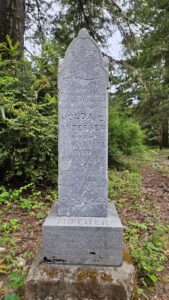
Hulda C. Andersen (née Johnson) 1873-1900

Headstone GPS Coordinates: 

Birth: January 15, 1873, Oland, Sweden

Death: August 27, 1900, Washington, USA

Relatives in Seabeck Cemetery: Oluf Andersen, Emel Andersen, Emma Andersen, August Johnson, Louisa Johnson

American Revolutionary War Patriots*: None Found

Oluf Andersen was born on September 24, 1860, in Christiansund, Norway, a coastal town shaped by maritime trade and fishing. In 1880, at the age of twenty, he left Norway and immigrated to the United States, joining the growing wave of Scandinavian settlers seeking opportunity in the Pacific Northwest. In time, Oluf became a naturalized U.S. citizen and established himself in the developing community of Seabeck in Washington Territory.

Hulda C. Johnson was born in Oland, Sweden, on January 15, 1873, and immigrated to the United States in the late 1880s as a young teenager. At just fourteen years old, she traveled with her parents, August Johnson and Britta Louisa Johnson (née Anderson), to America. The family settled in Seabeck, where many Scandinavian immigrants had formed a close-knit community rooted in shared language, culture, and Lutheran faith. It was there that Hulda met Oluf.

Oluf and Hulda were married on August 29, 1889, in Seabeck, Kitsap County, Washington Territory. Both were members of the Lutheran Church, which played an important role in their spiritual lives and community connections. The following year, in 1890, they welcomed their first child, marking the beginning of their family life together.

By the time of their marriage, Oluf and Hulda were living along the waterfront area of Seabeck that would come to be known as Andersen’s Landing, a name that endures to this day. There, they made their home and raised their children. Five children were born to them in Seabeck: Adolf (1890), Anna (1891), Emel (1893), Emma (1894), and Walter (1896). Their early years as parents were marked by both joy and sorrow. Emel and Emma tragically died when they were only days old, losses that would have weighed heavily on the family. Their surviving children—Adolf, Anna, and Walter—grew to adulthood and later established families of their own.

Oluf earned a living as a farm laborer, contributing to the agricultural work that sustained the Seabeck community during its early years. Life in the territory was demanding, and the family endured further hardship when Hulda died on August 27, 1900, at only twenty-seven years of age. The cause of her death is unknown, leaving a poignant gap in the family’s history.

Oluf lived for nearly nine years after Hulda’s death. He passed away on November 29, 1909, at Seattle General Hospital at the age of forty-nine. His death was attributed to chronic interstitial nephritis, a condition now commonly known as kidney failure.

Oluf and Hulda are buried in Seabeck Cemetery, laid to rest on either side of their infant children, Emel and Emma. Together, their graves tell the story of a young immigrant family shaped by faith, hard work, love, and loss, and firmly rooted in the early history of Seabeck.


Emma Andersen, 1894-1894


Headstone GPS Coordinates:

Birth: 9 Nov 1894, Seabeck, Kitsap County, Washington

Death: 30 Nov 1894 Seabeck, Kitsap County, Washington

Relatives in Seabeck Cemetery: Oluf Andersen, Hulda Andersen, Emel Andersen, August Johnson, Louisa Johnson

American Revolutionary War Patriots*: None Found


Emma Andersen was born on November 9, 1894, in Seabeck, Washington, to Oluf and Hulda Andersen (née Johnson). She was the couple’s fourth child, born into a family already familiar with both joy and loss.

Like her brother Emel, who had been born the previous year and lived only five days, Emma’s life was tragically brief. She passed away on November 30, 1894, at just twenty-one days old. The loss of a second infant child within such a short span would have been a profound heartbreak for her parents.

Emma was laid to rest in Seabeck Cemetery beside her brother Emel, marked by a modest upright granite headstone. Over time, the headstone sustained damage, but in 2025 it was carefully repaired by members of the Elizabeth Ellington Chapter of the National Society Daughters of the American Revolution (NSDAR), ensuring that her resting place continues to be respectfully marked and remembered.


Emel Andersen, 1893-1893


Headstone GPS Coordinates:

Birth: 07 June 1893, Seabeck, Kitsap County, Washington

Death: 12 June 1893, Seabeck, Kitsap County, Washington

Relatives in Seabeck Cemetery: Oluf Andersen, Hulda Andersen, Emma Andersen, August Johnson, Louisa Johnson

American Revolutionary War Patriots*: None Found


Emel Andersen was born on June 7, 1893, in Seabeck, Washington, to Oluf and Hulda Andersen (née Johnson). He was the couple’s third child and briefly joined a growing family rooted in the Seabeck community.

Tragically, Emel lived only five days. He passed away on June 12, 1893, in Seabeck. His cause of death was not recorded, a common circumstance for infant deaths of the era.

Emel was laid to rest with a small, flat, upright granite headstone. At some point over the years, the headstone was damaged, but in 2025 it was carefully repaired by members of the Elizabeth Ellington Chapter of the National Society Daughters of the American Revolution (NSDAR), ensuring that his resting place continues to be respectfully marked and remembered.