Infant Girl Moran (1882-1882)

Headstone GPS Coordinates: Burial location unknown.

Birth: 18 July 1882, Three Spits (Bangor), Kitsap County, Washington

Death: 18 July 1882,Three Spits (Bangor), Kitsap County, Washington

Relatives in Seabeck Cemetery: Sarah Moran

American Revolutionary War Patriots*: None


On July 18, 1882, in the remote logging settlement of Three Spits in Kitsap County (near present-day Naval Base Kitsap – Bangor), an infant girl Moran was born into a rugged and isolated frontier world—and died the same day.

She was the fourth child of Sarah Cartwright Moran and Thomas “Tommy” Moran, a lumberman whose work tied the family to the booming timber economy of Washington Territory. Her mother, Sarah, had been born on February 5, 1857, in Worcestershire, England, and had come to the Pacific Northwest as a young woman, working as a schoolteacher in Union City (now Union). Sarah and Thomas were married on May 31, 1877, in Victoria before settling along Hood Canal, where three sons were born: John William “Pat” (1878), Thomas Cartwright (1879), and Arthur Garfield (1880).

By the summer of 1882, the Morans were living at Three Spits, a small logging community north of Seabeck. Travel between settlements depended almost entirely on water routes across Hood Canal, as dense forests and primitive roads made overland journeys difficult and slow.

The infant girl’s birth proved tragic. Her mother died delivering her, and the baby did not survive. The following day, July 19, their bodies were carried by sloop across Hood Canal to Seabeck. On the morning of July 20, 1882, at 10:30 a.m., both were buried in Seabeck Cemetery by the caretaker, Jacob Hauptly.

Though unnamed in surviving records, the infant girl’s brief life was bound to her mother’s in both birth and burial. Her father later moved to Shelton, remarried, and continued raising the family. He died on January 10, 1915, and was buried in Shelton Memorial Park.

A curious mystery remains. Beside Thomas’s grave in Shelton stands a headstone for Sarah, inscribed with her birth and death dates. Yet cemetery records contain no evidence that Sarah—or her infant daughter—were ever reinterred there. The burial plot was not even purchased until 1911, nearly thirty years after their deaths, when an infant grandchild was laid to rest.

Whether Sarah’s marker was moved from Seabeck, or created later as a memorial tribute, remains unknown. As for the infant girl Moran, her life left no records beyond that single tragic day in July 1882—her story preserved only through the circumstances of her birth, death, and shared grave beside her mother.


Frank Milanoski, (1906-1907)

Headstone GPS Coordinates: Burial location unknown.

Birth: 23 October 1906, Seabeck, Kitsap County, Washington

Death: 8 January 1907, Seabeck, Kitsap County, Washington

Relatives in Seabeck Cemetery: None.

American Revolutionary War Patriots*: None


In the “Register of Deaths in Kitsap,” it is recorded that an infant named Frank Milanoski passed away from “convulsions” on January 8, 1907. His date of birth was listed as October 23, 1906, which means he was 77 days old when he died. The family’s residence was noted as Seabeck. Given the prevalence of post-neonatal deaths (infants older than 28 days) from water and foodborne diseases in that era, it is highly likely that Baby Frank succumbed to one of the many infectious illnesses that tragically claimed the lives of countless babies before the advent of modern public health measures like water sanitation and pasteurization.

It is highly probable that Baby Frank was born in the home of his maternal grandparents, Bernard and Martha Kaiser, as they were living in Seabeck at the time. His grandfather, Bernard, was working as a merchant in a retail store, suggesting the Milanoskis may have been residing with Mary’s family when their second born son was born and died. 

Baby Frank was likely buried in Seabeck Cemetery. It’s unknown where in the cemetery he is buried. 

Baby Frank’s parents, Frank Sr. and Mary, carried a history of migration and change. Frank Milanoski Sr. was born in St. Paul, Minnesota, in 1885, into a Polish immigrant family. He married Mary Kaiser in Minnesota in 1903. Mary, born in either Poland or Germany, was part of a family that had also migrated to the United States. Their first son, John, was born in Minnesota in 1904.

Sometime between 1904 and 1906, the young family moved west, settling in Seabeck, following Mary’s parents and siblings who had all moved to the Seattle area.

By the 1910 census, Frank and Mary were living in Seattle, where Frank worked as a motorman alongside his brother, John. Another son, Stanley, was born there in 1912.

Following Stanley’s birth, the Milanoskis returned to St. Paul, Minnesota. Their daughter, Helen, was born there in 1918, and by 1920, Frank Sr. had become a respected St. Paul policeman.

Life was stable and happy until tragedy struck a second time, shattering the family once more. While he was off duty and out driving with his wife and young children, Frank stopped his car to confront a former deputy sheriff for a traffic violation he had witnessed. An altercation erupted, and Frank was struck, fell backward, and suffered a fatal skull fracture on the sidewalk. The former deputy sheriff was arrested and charged with murder, and Frank Sr. is now listed in the United States Officer Down Memorial database.

Distraught and traumatized, Mary quickly moved back to Seattle with her young children to be near her siblings, possibly residing with her older brother, Bernard Kaiser. However, a third and final tragedy would soon follow. Mary Milanoski died in 1928 at the young age of 42 from lobar pneumonia and epilepsy. She was buried in Calvary Cemetery in Seattle. Her younger sons and her daughter were taken care of by her parents who were now residing in Seattle.

Baby Frank’s siblings grew up and lived their lives. Several moved to other states, but they probably wondered about their brother buried in Seabeck, Washington.


William C. McDonough, 1856-1888

Headstone GPS Coordinates:

Birth: 1856, Massachusetts

Death: 30 Oct 1888, Washington, USA

Relatives in Seabeck Cemetery: Ann Clements (née Donahue)

American Revolutionary War Patriots*: None

William C. McDonough was born around 1856 in Massachusetts. His father’s first name is unknown, but he was born in Ireland. William’s mother was named Ann Clements who was born in Maine to her English father John Clements and her Irish mother Ann Crawford. 

In 1860, William and his mother were living in his Clements grandparent’s household along with his young aunts and uncles. In 1868, his mother died at the age of thirty-two in Portland, Maine. By 1870, William was living with his aunt Deborah (Clements) Gaffany and her husband Patrick and their children in Machias, Maine. 

In 1880 when William was twenty-four, he had moved out to Dosewallips, Jefferson County in Washington to work in a logging camp. He likely traveled to the Washington Territory with his uncle John Clements and his wife Ann along with their family. His uncle Samuel Clements and wife Mary and their children had also made the trip and settled in Dosewallips.  Unfortunately that same year in 1880, William’s aunt Ann Clements died, and was buried in Seabeck Cemetery.

In 1885, William was living as a single man in Mason County working as a logger. On October 30, 1888 when he was thirty-two years old (the same age as his mother), he died from unknown reasons. He was buried near his aunt Ann Clements with a similar upright, marble obelisk headstone. 


John Werner Matson, 1894-1903

Headstone GPS Coordinates:

Birth: 21 April 1894, Seattle, Kitsap County, Washington

Death: 26 October 1903, Seabeck, Kitsap County, Washington

Relatives in Seabeck Cemetery: None.

American Revolutionary War Patriots*: None


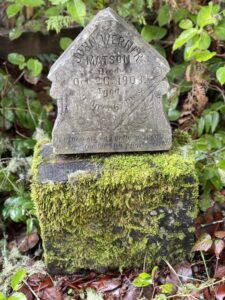
John Werner Matson was born on April 21,1894, in Seattle, Washington, to Finnish immigrants John E. Matson, a fisherman, and Mathilde Matson née Elfring. He was baptized on June 18th at Gethsemane Lutheran Church in Seattle; his sponsors (godparents) were his uncle, Otto Matson, and Edla Matson née Isaacson, both residents of Seabeck. According to notes by the late historian Fred Just, John tragically died at the age of nine after slipping from a log boom on which he was playing and drowning. His death was recorded in the Immanuel Lutheran Church records in Seattle.

In recent years, John’s headstone had been stolen out of the cemetery, but was thankfully found and returned by the Kitsap Sheriff’s Office.


Elizabeth “Lizzie” Emel Maher, 1875-1909

Headstone GPS Coordinates: 

Birth: 16 June 1875, possibly in Carrick Township, Bruce County, Ontario, Canada

Death: 29 April 1909, Seattle, King County, Washington

Relatives in Seabeck Cemetery: Peter Frank Emel, Ruby C. Emel

American Revolutionary War Patriots*: None.

Disclaimer: These lines have not been officially proven by NSDAR standards.


Elizabeth “Lizzie” Emel Maher was born on June 16, 1875, in Canada, likely in Carrick Township, Bruce County, Ontario. She was the eldest daughter of Peter Emel and his first wife, Anna Margaret Stroeder. When Elizabeth was just three years old, her mother died, leaving her and her two younger brothers, Frank and Peter, without their mother’s care.

Following Margaret’s death, Elizabeth’s father moved the young family to Polk County, Minnesota. By 1880, Elizabeth—then five years old—was living on a farm with her father and brothers, along with her Emel uncles André and Joseph and her aunt Barbara. That same year, her father married his second wife, Anna Litsen, adding four more brothers to Elizabeth’s growing family.

Around 1889, when Elizabeth was approximately fourteen years old, the Emel family relocated to Seattle. On May 9, 1895, Elizabeth married Thomas Francis Maher at Sacred Heart Catholic Church in Seattle. In 1896, she gave birth to twin sons, Frank and Charles. Elizabeth and her young family remained in Seattle, while her father and younger siblings later settled in Seabeck.

Elizabeth died on April 29, 1909, at Providence Hospital in Seattle, at the age of thirty-three. The cause of death was recorded as atrophy of the liver. When her father, Peter Emel, died in 1924, he was buried beside Elizabeth in Seabeck Cemetery, and the family placed a large joint headstone to mark their graves.

After Elizabeth’s death, her husband Thomas Francis Maher disappears from known records. Their son Frank was later traced to Dayton, Ohio, where he registered for the World War I draft. He was discharged from military service in 1919, after which the documentary record becomes unclear.

Elizabeth’s other son, Charles, experienced a far more tragic fate. He was admitted to Western State Hospital for the Insane in Steilacoom at the age of sixteen, suffering from what was described as mania. Charles remained institutionalized for the rest of his life and died there on November 26, 1923, at the age of twenty-six. His cause of death was recorded as dementia and exhaustion. He was buried in the hospital cemetery.


Clara E. Little (1868–1885)

Headstone GPS Coordinates:

Birth: 5 April 1868, Seabeck, Kitsap County, Washington

Death: 9 May 1885, Seabeck, Kitsap County, Washington

Relatives in Seabeck Cemetery: None.

American Revolutionary War Patriots*: None

Until the 1950s, a beautiful, ornately carved headstone stood in Seabeck Cemetery in memory of seventeen-year-old Clara E. Little, who died on May 9, 1885, from unknown causes.

Clara was the youngest child of one of Seabeck’s earliest families. Her father, Gilbert Little, and mother, Ellen (or Helen) Little née Walker, immigrated to the United States from Scotland in 1858. Gilbert was born in Wanlockhead, Scotland, though his family later moved to Dreghorn, Ayrshire. There, Gilbert and his two brothers worked in the coal mines, while his sister supported the family as a seamstress after their father’s death. Gilbert met Ellen in Ayrshire, and they married around 1856.

Shortly after their marriage, the young couple set sail for America. Ellen was likely pregnant at the time with their first child, Archibald Little, who was born in Chile during their journey to the west coast of the United States. By late 1858, the family had likely arrived in San Francisco, California. In 1860, they were living on Whidbey Island, Washington, where Gilbert and Ellen welcomed two more children, Isabelle and William.

Around 1863, the Little family moved to Seabeck, where Gilbert found work as a millworker for the Washington Mill Company, earning $50 per month. On April 5, 1868, their youngest child, Clara E. Little, was born.

Clara appears in both the 1870 and 1880 census records, living with her family in Seabeck. She was listed as a student and was able to read. Whether she was taken by illness or a tragic accident on May 9, 1885, is unknown, but her death was a devastating loss. Clara was laid to rest on Monday, May 11, 1885, at 5:00 p.m. in Seabeck Cemetery.

Her headstone reflected both heartbreak and hope for eternity. It featured a Lily of the Valley motif—symbolizing purity, innocence, renewal, and the return of happiness—and bore a poem that read:

“Hush Mother, I live still;
a bright loving angel;
earth was too cold for me;
here immortality;
safe, weep not.”

Clara’s headstone was photographed in the early 1950s, preserving its beauty. In February 1956, however, heavy winter rains and strong winds toppled an old-growth fir tree in the cemetery. The tree fell directly onto Clara’s grave, snapping her headstone in half and destroying nearby wooden plot fences. A second photograph documents the broken remains of the stone.

Today, nothing remains of Clara E. Little’s original headstone. The SCRP hopes to one day commission a replica, restoring a lasting memorial to a young life lost too soon.


Henry King Lewis, 1882-1882

Headstone GPS Coordinates:

Birth: 05 Feb 1882, Seabeck, Kitsap County, Washington

Death: 06 Feb 1882, Seabeck, Kitsap County, Washington

Relatives in Seabeck Cemetery: Elizabeth Lewis (née Fenn)

American Revolutionary War Patriots*: None


Henry King Lewis was born on February 5, 1882, in Seabeck, Washington, the son of Thomas John Lewis and Agatha Marie Lewis. His life was tragically brief; he died a day after he was born.

Henry was buried in Seabeck next to his grandmother, Elizabeth “Eliza” Lewis. His brother, Francis “Frank” Xavier Lewis—another son of Thomas and Agatha—later took special care of Henry’s burial site. Frank installed a cement border around both Henry’s grave and his grandmother’s grave and carved his initials into the cement.

According to family history shared by Frank with local historian Fred Just, the tree surrounding Henry’s headstone did not naturally grow around it. Instead, Frank intentionally cut a slot into the tree and placed Henry’s stone within it, creating a distinctive and deeply personal memorial.


Elizabeth “Eliza” Lewis (née Fenn), 1833-1913

Headstone GPS Coordinates:

Birth: 16 January 1833, Manningtree, Essex, England, United Kingdom

Death: 10 February 1913, Crosby, Kitsap County, Washington

Relatives in Seabeck Cemetery: Henry Lewis

American Revolutionary War Patriots*: None

Elizabeth “Eliza” Lewis (née Fenn) was born on January 16, 1833, in Manningtree, Essex, England. Her father was John Fenn of Woodbridge. There are conflicting records regarding the identity of Eliza’s mother.

In the book Thomas and Agatha: Kitsap County Pioneers, written in 1986 by a Lewis family descendant, Eliza’s mother is identified as Mary Ann Howard. However, the book’s citations list only Eliza’s father and do not name her mother. On Eliza’s death certificate, her son Thomas—who lived with his grandparents for a time—listed her mother as “Eliza Fenn.” A baptismal record dated January 22, 1833, from St. Michael and All Angels Church in Manningtree lists Eliza Fenn as the daughter of John Fenn and Elizabeth Fenn, and census records support this information. Based on this evidence, Eliza’s mother was very likely Elizabeth Fenn (maiden name unknown), who was born in Woodbridge, Suffolk County, England, around 1811.

On August 7, 1856, at the age of twenty-three, Eliza married Alfred King Lewis in Hackney, London, England. Alfred was a widower with a young daughter, Caroline, and worked as a shipwright for the Royal Navy, which frequently took him to sea. On April 9, 1857, Eliza and Alfred had a son, Thomas John Lewis. When Thomas was about two years old, Alfred died of a fever while at sea near China. It is unclear whether Thomas ever met his father.

By 1861, Eliza had sent young Thomas to live with her parents in Woodbridge while she worked as a servant in the household of Joseph Miles in Middlesex. On January 2, 1864, Eliza married her second husband, Walter Frederick Newton. According to Thomas and Agatha: Kitsap County Pioneers, Thomas and Walter did not get along. When Thomas was fourteen, he ran away from home and stowed away on a British merchant ship. By the time he was discovered, the vessel was too far out to sea to turn back, and Thomas was assigned work as a cabin boy for the captain and senior officers.

Life at sea did not suit Thomas. He reportedly attempted to jump ship in both Panama and the Hawaiian Islands, without success. In 1871, when the ship docked in San Francisco, Thomas managed to sneak ashore and hide. He worked various jobs on the San Francisco docks, eventually meeting Irish native Francis Xavier Olanie and his young daughter, Agatha Marie. Thomas and Agatha married in 1880, and in 1881 they sailed for Washington Territory, where they would eventually homestead in Seabeck and raise their family.

Before Thomas ran away, Eliza had two sons with Walter Newton: Frederick William Newton, born in 1864, and George Newton, born in 1866. Sometime between 1866 and 1871, Walter likely died. By 1871, Eliza had married James Blaker, a shipwright. The 1881 census shows Frederick and George Newton living in the Blaker household alongside Eliza and her children with James: James Blaker (born 1871) and William Blaker (born 1872). Eliza also had a daughter, Louisa Eliza Blaker, born in 1874, who lived only six months.

Also listed in the 1881 household was Eliza’s seventy-year-old mother, Elizabeth Fenn, who was widowed by that time; John Fenn had died in 1877. In September 1883, James Blaker died in London. Eliza’s mother, Elizabeth Fenn, passed away in 1888.

In 1890, Eliza left England for the United States and arrived in Seabeck, Washington, to live with her son Thomas, his wife Agatha, and their children. Eliza’s youngest son, William Blaker, also traveled to Seabeck, but tragedy soon followed. According to family accounts, William was a sailor who joined a ship carrying lumber to San Francisco. Thomas warned his younger half-brother not to go, believing the ship was overloaded, but William went anyway. The vessel never reached San Francisco, and William died with the rest of the crew in 1891.

On November 22, 1891, Agatha Lewis gave birth to a premature baby. Eliza placed the infant near the fireplace to keep him warm, and the child survived. Eliza was credited with saving his life and named him William, after her late son.

On August 13, 1894, Eliza married William Burn in Seattle, Washington. William owned large tracts of land in what is now Hintzville, though little additional information about him has been found.

By the 1910 census, Eliza was once again living with Thomas and Agatha and their younger children. She was listed as “Eliza Lewis,” marked as “married,” with the number “4” indicating she had been married four times. She may have been living with Thomas and Agatha in 1906 when their house burned down, destroying some of the finer possessions she had brought with her from England.

Eliza died at the age of eighty on February 10, 1913, in Crosby, Washington. On her death certificate, completed by Thomas Lewis, she is listed as “Mrs. Eliza Lewis” and a “widow.” Her headstone reads: “Grandmother; Elizabeth Lewis; BORN Jan. 16, 1833 — DIED Feb. 10, 1913.” She was buried in Seabeck next to her grandson Henry Lewis, the son of Thomas and Agatha, who was born February 5, 1882 then died a day later. 

The late historian Fred Just knew Francis “Frank” Xavier Lewis, son of Thomas and Agatha, who lived from 1896 to 1980 in Kitsap County. Frank installed a cement border around his brother’s and grandmother’s graves and carved his initials into it. Frank told Fred that the tree surrounding Henry’s headstone did not grow naturally around it; instead, Francis cut a slot into the tree and placed Henry’s stone there himself.


Richard Lantz, 1872-1878

Headstone GPS Coordinates: Burial location is unknown.

Birth: April 1872, Oregon or Washington, USA

Death: 20 August 1878, Seabeck, Kitsap County, Washington

Relatives in Seabeck Cemetery: Bengta Lantz

American Revolutionary War Patriots*: None


Richard Lantz was born in April 1872, approximately two years after his parents emigrated from Sweden to North America. It’s unknown where exactly he was born, but it was likely somewhere in Oregon or Washington.

By 1878, Richard was living with his family at Miami Beach, Washington Territory, where his father worked as a fisherman. On August 20, 1878, Richard drowned at the age of six years and four months. An inquest was held the following morning, with the verdict recorded as accidental drowning.

The death and burial arrangements were documented in detail by Jacob Hauptly in his diary:

August 22, 1878:
“The little boy (6 years & 4 mo. old) of John Lantz was drowned last night. I held an inquest on him this morning. Verdict – accidental drowning. I was busy all day going round with subscription to raise money to pay burying expenses and to give the balance to the mother of the boy. Husband a no account. I collected about $55.”

August 23, 1878:
“I was busy arranging for burial of the corpse (Richard Lantz drowned). We had the funeral after supper, quite a turnout.”

August 26, 1878:
“I paid Mrs. Lantz $35.50 and gave Maggie Davis $12 to make some clothes for Lantz’s children. Kept out $5 for making the coffin.”

Richard was buried in Seabeck Cemetery shortly after his death. The exact location of his grave is unknown, and there is no record of a grave marker ever having been placed.

Richard’s mother, Bengta Arvidsdotter Lantz, died on April 4, 1880, less than two years after his death, and is also believed to be buried in Seabeck Cemetery. The burial locations of both mother and son remain unidentified in existing records.


Bengta Arvidsdotter Lantz, 1838-1880

Headstone GPS Coordinates: Burial location is unknown.

Birth: 20 April 1838, Kattarp, Laholms landsförsamling, Halland, Sweden

Death: 4 April 1880, Seabeck, Kitsap County, Washington

Relatives in Seabeck Cemetery: Richard Lantz

American Revolutionary War Patriots*: None


Bengta Arvidsdotter Lantz was born on April 20, 1838, in Kattarp, Laholms landsförsamling, Halland, Sweden, to Arvid Bengtsson and Johanna Svensdotter. She was one of seven children.

In the 1865 Swedish census, Bengta was twenty-seven years old and living next door to her parents, who were residing in the household of Pål Bengtsson and Anna Aeridsdotter. Bengta was working for them as a maid. The census lists Bengta and her parents as Baptists.

On November 6, 1865, Bengta moved approximately thirty-five miles to Traryd in Kronoberg County, where she may have met Johan Lorentz Danielsson, later known as John Lantz.

On September 10, 1866, Bengta gave birth to an illegitimate daughter with Johan Lorentz Danielsson. A record from early 1870 noted that Johan—by then called John—was a soldier and Bengta was a maid. The same record stated that the pastor of Laholms Church had announced their intention to marry on three consecutive Sundays and that the couple planned to emigrate to America in 1870. Tragically, before they left Sweden, their daughter died at the age of three on April 27, 1870, in Kronoberg. The record also noted that the child was unbaptized.

Less than a month after their daughter’s death, on May 13, 1870, John and Bengta left Sweden and sailed to North America. On the emigration record, they were listed as an engaged couple, indicating that they did not marry in Sweden. To date, no marriage record for them has been found in the United States.

In April 1872, their son Richard Lantz was born. It is unclear whether he was born in Oregon or Washington. In 1875, Bengta and John had a daughter named Sarah. The Washington Territory census lists Sarah as being born in Oregon, while the 1880 U.S. Federal census lists her birthplace as Washington. She was also described in the census as “Deaf. Blind. Idiotic.” In 1878, Bengta gave birth to another daughter, Mary, who was listed in the 1880 census as “blind.”

By 1878, the Lantz family was living at Miami Beach, where John worked as a fisherman. That year, tragedy struck again when their six-year-old son Richard drowned on August 20. Jacob Hauptly recorded the incident in his diary:

1878, August 22, Thursday.

“The little boy (6 years & 4 mo. old) of John Lantz was drowned last night. I held an inquest on him this morning. Verdict – accidental drowning. I was busy all day going round with subscription to raise money to pay burying expenses and to give the balance to the mother of the boy. Husband a no account. I collected about $55.”


1878, August 23, Friday.

“I was busy arranging for burial of the corpse (Richard Lantz drowned). We had the funeral after supper, quite a turnout.”


1878, August 26, Monday.

“I paid Mrs. Lantz $35.50 and gave Maggie Davis $12 to make some clothes for Lantz’s children. Kept out $5 for making the coffin.”


Approximately two years later, on April 4, 1880, Bengta died at the age of forty-one. Jacob Hauptly noted in his diary on April 6, “Mrs. Lantz was buried at 4 p.m.” Her death was also reported in The Seattle Post-Intelligencer on April 9, 1880: “Mrs. Lantz, wife of John Lantz, a fisherman in Seabeck, died there on Sunday last.”

In Fred Just’s book Seabeck and the Surrounding Area and Fredi Perry’s Tide’s Out, Table’s Set, Bengta is listed simply as “Mrs. Lantz” in the Seabeck Cemetery burial list. The SCRP research team is pleased to have uncovered additional records that reveal Mrs. Lantz’s full name and her origin story.

The exact burial locations of Bengta and her son Richard within Seabeck Cemetery are unknown, and there are no records indicating that grave markers were ever present.