
Nathaniel J. Sargent, (1863-1954)
Headstone GPS Coordinates:
Birth: 4 July 1863, poss. Hopkinsville, Christian County, Kentucky
Death: 16 August 1954, Seattle, King County, Washington
Relatives in Seabeck Cemetery: None.
American Revolutionary War Patriots*: Unknown.
Disclaimer: These lines have not been officially proven by NSDAR standards
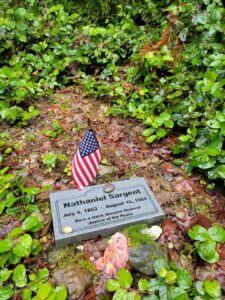
One of the most beloved original residents of Crosby and Seabeck was a man named Nathaniel J. Sargent. He was one of the few long time Black homesteaders in Kitsap county and is the only known Black person buried in Seabeck Cemetery.
A summary of Nathaniel’s life was published in the “Kitsap: A History” book:
He was, the oldtimers said, the whitest man in Crosby, despite the fact that his skin was black. Nathaniel J. Sargent (b. July 4, 1863,Kentucky; d. Aug. 16, 1954, Seattle) was known as “Nat” to his friends. He was born into slavery and after emancipation was adopted by a white family in the north. They sent him to the University of Illinois where he graduated, then came west with his family to Oregon.
Because Oregon laws forbad Negroes, he came to Kitsap County where he earned a living working in the woods as a logger. He homesteaded in Crosby after his arrival in 1882, and as settlers started arriving, he worked as a handyman alongside the homesteaders, building their homes, starting their orchards, butchering, harvesting. He was their friend although he never “imposed” and was often an invited guest.
The day after he passed away, Nathaniel had his obituary published in the Kitsap Sun newspaper on August 17, 1954 that described more of his life:
Resident 72 Years In Area, Beloved Negro Man, Dies.
Seventy-two years in Kitsap county came to an end yesterday for Nathaniel Sargent, 91-year-old beloved Negro resident of the Crosby-Holly area who died at a Seattle hospital. Hospitalized first in Bremerton in 1951, the elderly rancher was moved to Seattle a year ago. Coming to Kitsap county in 1882, Mr. Sargent, a bachelor, homesteaded soon after that on a ranch in Crosby-Holly area which became his home for life.
A graduate of the University of Illinois and possessing a brilliant mind, he preferred the secluded life his ranch offered and spent his leisure hours creating beautiful oil paintings or writing verse, some of which were sold.
Along with his ranch income he made a living at logging camps around Seabeck, cutting wood or doing odd chores in the community. Up until four years ago, when his health declined, Mr. Sergeant amazed his neighbors by his ability to walk to Bremerton and home again in one day.
In 1894, he was elected justice of the peace of Seabeck.
Mr. Sargent was born in Kentucky July 4, 1863. His home address was Star Rte. 1, Box 512. There are no known survivors. Funeral services will be held at Miller-Reynolds chapel Thursday at 10:30 a.m. with the Rev. Fred Opperman officiating. Burial will follow in Seabeck Cemetery.
There are many stories about Nathaniel and his friendships with his neighbors in the Seabeck and Kitsap county history books. However, not much is known about Nathaniel’s life before he came out to the Washington Territory in 1882 when he was 19 years old. On his death certificate, the names of his parents were not recorded and there was no mention of him having any family.
The Seabeck Cemetery Restoration Project research team took on the task of combing through the genealogical databases to see if there were any records from Nathaniel’s early life. Luckily, many records were found that paint a beautiful, yet heartbreaking picture of Nathaniel’s childhood, and the people who helped shape this man from Crosby.
Slavery and the Civil War
Nathaniel Sargent was born on July 4, 1863 in Kentucky into slavery. His parents were John and Mary Sargent, and he had an older brother named John born on May 3, 1860.
Nathaniel’s father, John, was born around 1840 and grew up in Christian county, Kentucky. Mary, Nathaniel’s mother, was born around 1837 in Kentucky. Going off the possibility that the Sargent surname may have come from a White enslaver, there were four white “Sargeant” households in Christian county listed in the 1860 U.S. Federal Census Slave Schedules. One of those households belonged to a John H. Sargeant of Hopkinsville who owned 17 slaves. Three of those slaves listed were a 21-year-old male, a 22 year old female, and another was a 1-year old male. These three could have been John, Mary, and John Sargent.
When Nathaniel was 6-months old, his father traveled 28 miles across the Kentucky state line to Clarksville, Tennessee and enlisted into the 16th Regiment of the U.S. Colored Infantry of the Union Army on December 21st, 1863 for a three year term. He was assigned to Company E as a Private. He was 23 years old and described as 5’ 6” tall with brown eyes and brown hair on his enlistment papers. John’s regiment was sent to Nashville to build fortifications and railroads to prepare for the inevitable Battle of Nashville when the Confederate forces would try to take back the city from the Union Army. Sadly, John died less than four months into his enlistment from enteritis in Hospital 16 in Nashville on April 10, 1864. He had been sick since March. He was buried with a white military headstone in the Nashville National Cemetery.
There’s no known record that places Nathaniel and his mother Mary and older brother John in Nashville, but there is a strong possibility that they were living there when a man named Benjamin Cravens arrived.
Benjamin Cravens of Winnebago county, Illinois
Benjamin Cravens was also a former slave from Christian County, Kentucky. He was born around 1820. By 1863, he was living in Laona, Winnebago county, Illinois. On March 1, 1865, he enlisted into the 15th Regiment U.S. Colored Infantry and was assigned to Company H in Marengo, Illinois. The regiment was sent to Nashville, Tennessee. During his service, Benjamin worked as a company cook, but on July 7th, he became ill. He served the rest of his service sick in a hospital until his term expired on March 1, 1866 when he was honorably discharged. It’s very possible that during his time while sick in the hospital he met Mary Sargent and her young sons. Since Benjamin was from Christian county, KY, he may have known Mary and her late husband John. What is shown in the records is that Benjamin returned back to Winnebago county, Illinois with his regiment in March 1866. In the 1870 census, Mary (now Cravens) was listed living in Benjamin’s household as his wife along with her eldest son John Sergeant in Durand, Winnebago County, Illinois. Nathaniel was also listed on the 1870 census in Winnebago county, but was living with a white couple 9 miles away in Harrison.
The Smith Family
Winnebago county was established in 1836 and was inhabited by New England transplants mainly from upstate New York. Northwest of the county seat of Rockford, sits the Harrison township. On the 1865 census, a white couple named Belden and Sarah Smith owned a farm. Belden Smith was born in 1813 in Putnam county, New York. He married Sarah Mettler in 1841. Sarah Mettler was born in 1820 in Pennsylvania. She was the daughter of Ralph Mettler and Mary Houseweart. The family moved to New York where Ralph became known as a vocal abolitionist. In 1840, he sold his farm in New York and purchased land in Rockford, Winnebago county, Illinois.
Sarah and Belden had a son named Floyd born in 1844 and a daughter named Anna born in 1850 while they were living in New York. Their marriage was tumultuous because of Belden’s excessive drinking habit and bad temper. Sarah took her two children and moved to Illinois and lived with her family, leaving Belden behind in New York. Belden eventually followed and the couple reunited in the early 1860s. In 1865, Belden and Sarah were living in the same household on their own farm in Harrison. Their son Floyd was serving in the Union Army and Anna was living with other relatives at this time.
Floyd Smith
Floyd Smith kept personal diaries, wrote about the weather and his daily activities for much of his life after the Civil War until his death. Many of his volumes still survive today with his descendants. On February 3, 1867, Floyd wrote:
“Warm(.) Helped George put up Mrs Dunnings Stove went to Durand with the 3 girls, Mother brought Nat home.”
This is the first mention of Nathaniel Sargent in Winnebago county. He would have been three years old at this time. Stories about Nathaniel and his family were passed down to the living descendants of the Smith family. One story is that Nathaniel’s mother Mary was very sick with consumption when she asked Sarah to take in Nathaniel. Nathaniel’s seven year old brother John stayed with Mary and Benjamin Cravens in Durand. It’s uncertain exactly when, but Mary may have just had given birth to her daughter Georgiana Cravens by this time.
On the 1870 census, Nathaniel was listed as living with Belden and Sarah in Harrison. He was listed as “white” and born in “Tennessee.” This was likely a mistake given to the enumerator possibly because Nathaniel came from Tennessee when he arrived in Illinois with his mother and Benjamin Cravens. This is the only time Nathaniel was recorded as being born in Tennessee on a census. All the proceeding census records list his birth place in Kentucky. Also, the enumerator likely didn’t set eyes on Nathaniel and put his race down as “white.” In the 1870 census in Durand, Benjamin and Mary Cravens along with John Sargent who was 10 years old at this time, were listed as living in the same household. A town record states that Georgiana Cravens had died by this time and was buried in Oakland Cemetery in Durand.
In 1871, Belden and Sarah divorced. Belden went to live with his cousin in Kane county, Illinois. Nathaniel stayed with Sarah on the farm in Harrison. Around this time Sarah’s grown and unmarried children Floyd and Anna came to live in the household. Floyd worked the farm and Anna worked as a music teacher. Nathaniel was known to be a painter and poet when he lived in Washington. Anna likely helped nurture and develop the creative side of him.
There are several mentions of Nathaniel “Nat” in Floyd’s diaries going with Floyd to Durand in 1867 likely to visit his mother and brother. Over the years, Nathaniel was mentioned in Floyd’s diary doing farm work such as dragging rye, plucking chickens, or crushing apples for cider. As Nathaniel grew up, he was trained as a barber and worked in Rockford. In Seabeck, Nathaniel was known to give haircuts for his neighbors and their families.
George H. Joslin
At some point after 1870, Mary Cravens had another son named Abraham, but on April 25, 1872 at the age of 42, she died. She is buried in Oakland Cemetery in Durand with a headstone.
On March 15, 1875, John and Nathaniel came under the guardianship of George H. Joslin, a white resident of Rockford, Illinois. In George’s obituary, it mentioned he served as a justice of the peace. George may have been the one to educate and taught him the necessary skills Nathanel needed to fulfill the role of justice of the peace when he was elected to the position in 1894 in Seabeck.
Nathaniel was 12 years old and his older brother John was 15 when they came under George’s guardianship. Since John was over 14, he was able to petition the court that he and his brother “are entitled to a pension on account of their late father who died while a private in the United States Army in the late War of the Rebellion, the amount of which is unknown. That they are also entitled to back pay of said deceased the probable amount of which is about one hundred and fifty eight dollars. That your petition John Sargent hereby nominates the said George H. Joslin to be his guardian.”
It’s a bit unclear if John and Nathaniel ever lived in George’s household because in 1880, Nathaniel was living with Floyd Smith on the farm in Harrison, and Nathaniel, who was 18 years old at the time, elected to have Floyd Smith as his guardian. Like his brother, Nathaniel petitioned the court that he was entitled to his father’s war pension. By this time, John, who was 21 years old, moved away to Chicago. It’s uncertain if either of the Sargent boys ever received their father’s war pension.
In 1882, Nathaniel’s brother John married Henrietta Mason in Aurora, Kane county, Illinois. His profession was listed as “railroad.” At some point, the couple moved to Indiana, possibly Indianapolis, and had a daughter named Olivia born in 1887. Olivia shows up in the 1900 census living with her aunt Florence Mason Adams in Chicago. On the 1940 census, there is a John Sargent listed in Indianapolis as a widower. Research is still being done to find out where and when he passed away. In none of Nathaniel’s obituaries does it mention he had a brother, so it’s not known now if they ever stayed in touch.
Homesteading in Washington and returning to the Midwest
In 1882, Nathaniel traveled west to Kitsap county, Washington, and soon purchased land in the Crosby area. It’s unclear if Nathaniel traveled alone or with members of the Smith family the first time he arrived in the PNW.
In 1894, he was elected Justice of the Peace of Seabeck and served for one year. In 1898, Nathaniel traveled back east to Illinois to visit the Smith family. He was mentioned in the The Daily Register Gazette in February “Nathaniel Sargent will work for Harry Graham this year…”
In 1900, Nathaniel was listed on the census in Delavan, Walworth, Wisconsin boarding with a Black couple named William and Nellie Hamlet née Logan. Nellie was the daughter of Benjamin Cravens’ second wife Mary Logan. Besides visiting with his family, Nathaniel was hoping to find a wife to bring back with him to his homestead in Crosby, Washington. Sadly, he left the Midwest with no wife. He likely returned to Washington in 1904 possibly with Anna Bradley née Smith and her husband Elihu J. Bradley. Anna and Elihu had planned to return to the Midwest when Mr. Bradley was offered a position at the Aberdeen State Bank. The couple settled and became prominent figures in the Aberdeen community. Elihu died in 1934 and Anna lived as a lone, wealthy widow until she died in 1935. They never had any children. Before Anna passed, she rewrote her will to leave her fortune to her cats and nurse maid, and to several of her friends. One of the friends she listed was Nathaniel Sargent to whom she left $1,000.
Family
In 1882, Nathaniel’s brother John married Henrietta Mason in Aurora, Kane county, Illinois. His profession was listed as “railroad.” At some point, the couple moved to Indiana, possibly Indianapolis, and had a daughter named Olivia born in 1887. Olivia shows up in the 1900 census living with her aunt Florence Mason Adams in Chicago. On the 1940 census, there is a John Sargent listed in Indianapolis as a widower. Research is still being done to find out where and when he passed away.
Nathaniel’s half-siblings died young. Georgiana died on April 12, 1869 when she was 1 year, 2 month, and 18 days old. Abraham died on February 8, 1878 when he was 4 years old. They were both buried in Oakland Cemetery in Durand, Illinois with headstones.
Benjamin Cravens remarried in 1878 in Wisconsin to a woman named Mary Logan. She had two daughters named Etta and Nellie and a son Martin with her first marriage. Benjamin and Mary had two sons of their own, Paul and Silas. Benjamin died in Durand in a military veterans home in 1882. He was buried in Quincy, Illinois with an upright marble military headstone.
Nathaniel did stay in close contact with the Smith Family. A postcard with a note written by Nathaniel Sargent to Floyd Smith still exists. His adoptive mother Sarah passed away in 1892 at the age of 72. Floyd Smith sold the family farm and moved to Rockford. He married Martha Graham in 1881 and had three daughters. He died in 1916 at the age of 72.
George Joslin died in 1881 from a sudden heart attack. One of his daughters, Julia moved out to Seattle with her husband Martin Sarver and their children. She may have visited Nathaniel in Crosby.
Remembering Nat
Nathaniel is buried in the southwestern corner of the Seabeck cemetery. His grave had no marker for many years until the Seabeck Conference Center commissioned one in the 2010s so this ordinary man who lived an extraordinary life will always be remembered in his community.