Gustaf Scott, (1841-1926)

Headstone GPS Coordinates: Burial location unknown.

Birth: 22 August 1841, Marbäck, Östergötland, Sweden

Death: 6 September 1926, Seattle, King County, Washington

Relatives in Seabeck Cemetery: Sophia Scott née Fredel

American Revolutionary War Patriots*: None.

Disclaimer: These lines have not been officially proven by NSDAR standards


Gustaf Emil Adolfsson Skott was born on August 22, 1841, in Marbäck, Östergötland, Sweden. He was the son of Adolf Mård Pettersson (1819–1900) and Maja Christina “Stina” Larsdotter (1811–1888), and he grew up as the second oldest of their eight children.

On November 6, 1870, Gustaf married Sophia Susanna Eriksdotter Fredel in Marbäck. Sophia had been born on June 3, 1849, in Lommaryd, Jönköping, Sweden, the first of three children born to Erik Johan Fredel (1822–1890) and Anna Stina Johansdotter (1822–1855). Her father worked as a carpenter, and her mother died when Sophia was just five years old. After her father remarried, Sophia gained eleven half-siblings.

Gustaf and Sophia began their family in Marbäck, where their first five children were born: Gustaf Emil Jr. (1871–1964), Sophia Olivia “Olive” (1873–1948), Carl Oscar (1876–1961), Maria Lovisa “Mary Louise” (1878–1953), and Johan Aron “John Aaron” (1881–1930). Before the family made their permanent move, Gustaf traveled alone to the United States and back to Sweden twice. Finally, on August 5, 1881, they departed together from the port of Göteborg aboard the SS Romeo, stopping in Hull, England, before continuing on to America. They landed in Philadelphia and eventually made their way to Cass County, North Dakota. The long journey by sea and land must surely have been arduous with five small children in tow, including a newborn.

The family arrived in North Dakota during the height of the Dakota Boom, when the Dakota Territory was rapidly filling with settlers and becoming a center of farming. Most were recent European immigrants. Many lived in sod houses and formed colonies, with the largest Norwegian settlement centered around Fargo in Cass County. While there, Gustaf and Sophia’s sixth child, Edith Mable (1884–1978), was born in 1884.

By 1887 the boom had ended. Drought and declining wheat prices strained homesteaders, and many began to move on. This may well have been the case for Gustaf and his family. By 1885 they had relocated to Marsh Grove in Marshall County, Minnesota, becoming one of the town’s first pioneer families. The area—named for its marshes and poplar groves—was being settled and farmed largely by Norwegian immigrants. Settlers cleared the land of trees, planted crops, and harvested by hand. In Marshall County, Gustaf and Sophia welcomed three more children: Albert T. (1886–1979), Edith Wilhelmina (1890–1992), and Hulda Clara (1891–1991).

After seven years in Minnesota, Gustaf brought his family west, arriving in Seattle in 1892. Around this time, he became a naturalized United States citizen and began using the spelling “Scott” instead of “Skott” for the family name.

The family homesteaded near the Norton precinct in Coyle, Jefferson County, west of Seattle on the southern tip of the Toandos Peninsula. This rural community, situated along the shores of Hood Canal, was known at the time as “Fisherman’s Harbor”—a fitting name, as Gustaf worked there as a fisherman. The area called Norton was named after Frank Norton, who built a cabin there in 1874. Earlier, pioneer Marshall Blinn had acquired much of the southern peninsula around 1862 and established a logging camp and sawmill in Seabeck across the canal. Much of that land was later deeded to the Washington Mill Company and Puget Mill Company. Fisherman’s Harbor was officially renamed Coyle in 1908, after the town’s first postmaster, when its first post office was established. Residents could travel to Seabeck by mailboat, which ran between Seabeck, Coyle, and Brinnon.

In 1893, Gustaf and Sophia’s tenth and final child, Otilia Matilda Dorothy “Tillie” (1893–1984), was born in Coyle. By 1900, six of their children were grown and living throughout the Puget Sound region, most with families of their own. The younger children attended the town’s one-room log schoolhouse with about fifteen other students. In 1910, only Tillie remained at home, along with two young boarders, eight-year-old Ida Holten and four-year-old Samuel Holten. Despite their young ages, they do not appear to have been related to the Scott family, and how they came to live there remains unclear.

Two of Gustaf’s sons, Albert and John, stayed in Norton. Albert worked as an engineer operating a “steam donkey,” a steam-powered winch used in logging and maritime work. By 1909, John owned and operated the town’s general store and, by 1911, also served as the town barber.

In 1918, the Flu Pandemic swept across the United States and Europe. On March 14, 1918, after eleven days of illness, Sophia died of broncho-pneumonia in Coyle at the age of 68. Two days later she was brought to Seabeck and buried in Seabeck Cemetery.

By 1920, Gustaf was retired and living at home. His son John and John’s wife, Félicie (née Virolle, 1889–1969), were living with him. John, a “farm fisher,” had returned to Norton after serving in France during World War I. It was there he met and married Félicie in 1919 before bringing her back to the United States.

During the final two years of his life, Gustaf moved to Seattle to live with his oldest son, Gustaf, at 13 West Dravus Street. On September 6, 1926, at the age of 85, Gustaf died at Norwegian Hospital in Seattle after battling senility and cancer of the lip, face, mouth, and neck for three years. Six days later, he was brought back to Hood Canal and laid to rest beside Sophia in Seabeck Cemetery. Sadly, no headstone or grave marker remains to mark where they are buried.


Nathaniel J. Sargent, (1863-1954)

Headstone GPS Coordinates:

Birth: 4 July 1863, poss. Hopkinsville, Christian County, Kentucky

Death: 16 August 1954, Seattle, King County, Washington

Relatives in Seabeck Cemetery: None.

American Revolutionary War Patriots*: Unknown.

Disclaimer: These lines have not been officially proven by NSDAR standards
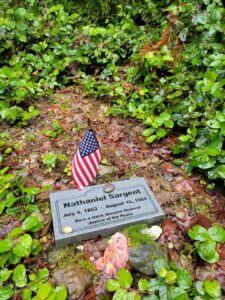
One of the most beloved original residents of Crosby and Seabeck was a man named Nathaniel J. Sargent. He was one of the few long time Black homesteaders in Kitsap county and is the only known Black person buried in Seabeck Cemetery.

A summary of Nathaniel’s life was published in the “Kitsap: A History” book:

He was, the oldtimers said, the whitest man in Crosby, despite the fact that his skin was black. Nathaniel J. Sargent (b. July 4, 1863,Kentucky; d. Aug. 16, 1954, Seattle) was known as “Nat” to his friends. He was born into slavery and after emancipation was adopted by a white family in the north. They sent him to the University of Illinois where he graduated, then came west with his family to Oregon.

Because Oregon laws forbad Negroes, he came to Kitsap County where he earned a living working in the woods as a logger. He homesteaded in Crosby after his arrival in 1882, and as settlers started arriving, he worked as a handyman alongside the homesteaders, building their homes, starting their orchards, butchering, harvesting. He was their friend although he never “imposed” and was often an invited guest.

The day after he passed away, Nathaniel had his obituary published in the Kitsap Sun newspaper  on August 17, 1954 that described more of his life:

Resident 72 Years In Area, Beloved Negro Man, Dies.

Seventy-two years in Kitsap county came to an end yesterday for Nathaniel Sargent, 91-year-old beloved Negro resident of the Crosby-Holly area who died at a Seattle hospital. Hospitalized first in Bremerton in 1951, the elderly rancher was moved to Seattle a year ago. Coming to Kitsap county in 1882, Mr. Sargent, a bachelor, homesteaded soon after that on a ranch in Crosby-Holly area which became his home for life. 

A graduate of the University of Illinois and possessing a brilliant mind, he preferred the secluded life his ranch offered and spent his leisure hours creating beautiful oil paintings or writing verse, some of which were sold.

Along with his ranch income he made a living at logging camps around Seabeck, cutting wood or doing odd chores in the community. Up until four years ago, when his health declined, Mr. Sergeant amazed his neighbors by his ability to walk to Bremerton and home again in one day. 

In 1894, he was elected justice of the peace of Seabeck. 

Mr. Sargent was born in Kentucky July 4, 1863. His home address was Star Rte. 1, Box 512. There are no known survivors. Funeral services will be held at Miller-Reynolds chapel Thursday at 10:30 a.m. with the Rev. Fred Opperman officiating. Burial will follow in Seabeck Cemetery. 

There are many stories about Nathaniel and his friendships with his neighbors in the Seabeck and Kitsap county history books. However, not much is known about Nathaniel’s life before he came out to the Washington Territory in 1882 when he was 19 years old. On his death certificate, the names of his parents were not recorded and there was no mention of him having any family. 

The Seabeck Cemetery Restoration Project research team took on the task of combing through the genealogical databases to see if there were any records from Nathaniel’s early life.  Luckily, many records were found that paint a beautiful, yet heartbreaking picture of Nathaniel’s childhood, and the people who helped shape this man from Crosby.

Slavery and the Civil War

Nathaniel Sargent was born on July 4, 1863 in Kentucky into slavery. His parents were John and Mary Sargent, and he had an older brother named John born on May 3, 1860. 

Nathaniel’s father, John, was born around 1840 and grew up in Christian county, Kentucky. Mary, Nathaniel’s mother, was born around 1837 in Kentucky. Going off the possibility that the Sargent surname may have come from a White enslaver, there were four white “Sargeant” households in Christian county listed in the 1860 U.S. Federal Census Slave Schedules. One of those households belonged to a John H. Sargeant of Hopkinsville who owned 17 slaves. Three of those slaves listed were a 21-year-old male, a 22 year old female, and another was a 1-year old male. These three could have been John, Mary, and John Sargent. 

When Nathaniel was 6-months old, his father traveled 28 miles across the Kentucky state line to Clarksville, Tennessee and enlisted into the 16th Regiment of the U.S. Colored Infantry of the Union Army on December 21st, 1863 for a three year term. He was assigned to Company E as a Private. He was 23 years old and described as 5’ 6” tall with brown eyes and brown hair on his enlistment papers. John’s regiment was sent to Nashville to build fortifications and railroads to prepare for the inevitable Battle of Nashville when the Confederate forces would try to take back the city from the Union Army. Sadly, John died less than four months into his enlistment from enteritis in Hospital 16 in Nashville on April 10, 1864. He had been sick since March. He was buried with a white military headstone in the Nashville National Cemetery.

There’s no known record that places Nathaniel and his mother Mary and older brother John in Nashville, but there is a strong possibility that they were living there when a man named Benjamin Cravens arrived.

Benjamin Cravens of Winnebago county, Illinois

Benjamin Cravens was also a former slave from Christian County, Kentucky. He was born around 1820.  By 1863, he was living in Laona, Winnebago county, Illinois. On March 1, 1865, he enlisted into the 15th Regiment U.S. Colored Infantry and was assigned to Company H in Marengo, Illinois. The regiment was sent to Nashville, Tennessee. During his service, Benjamin worked as a company cook, but on July 7th, he became ill. He served the rest of his service sick in a hospital until his term expired on March 1, 1866 when he was honorably discharged.  It’s very possible that during his time while sick in the hospital he met Mary Sargent and her young sons. Since Benjamin was from Christian county, KY, he may have known Mary and her late husband John. What is shown in the records is that Benjamin returned back to Winnebago county, Illinois with his regiment in March 1866. In the 1870 census, Mary (now Cravens) was listed living in Benjamin’s household as his wife along with her eldest son John Sergeant in Durand, Winnebago County, Illinois. Nathaniel was also listed on the 1870 census in Winnebago county, but was living with a white couple 9 miles away in Harrison. 

The Smith Family 

Winnebago county was established in 1836 and was inhabited by New England transplants mainly from upstate New York. Northwest of the county seat of Rockford, sits the Harrison township. On the 1865 census, a white couple named Belden and Sarah Smith owned a farm. Belden Smith was born in 1813 in Putnam county, New York. He married Sarah Mettler in 1841. Sarah Mettler was born in 1820 in Pennsylvania. She was the daughter of Ralph Mettler and Mary Houseweart. The family moved to New York where Ralph became known as a vocal abolitionist. In 1840, he sold his farm in New York and purchased land in Rockford, Winnebago county, Illinois. 

Sarah and Belden had a son named Floyd born in 1844 and a daughter named Anna born in 1850 while they were living in New York. Their marriage was tumultuous because of Belden’s excessive drinking habit and bad temper. Sarah took her two children and moved to Illinois and lived with her family, leaving Belden behind in New York. Belden eventually followed and the couple reunited in the early 1860s. In 1865, Belden and Sarah were living in the same household on their own farm in Harrison. Their son Floyd was serving in the Union Army and Anna was living with other relatives at this time.

Floyd Smith

Floyd Smith kept personal diaries, wrote about the weather and his daily activities for much of his life after the Civil War until his death. Many of his volumes still survive today with his descendants. On February 3, 1867, Floyd wrote:

“Warm(.) Helped George put up Mrs Dunnings Stove went to Durand with the 3 girls, Mother brought Nat home.”

This is the first mention of Nathaniel Sargent in Winnebago county. He would have been three years old at this time. Stories about Nathaniel and his family were passed down to the living descendants of the Smith family. One story is that Nathaniel’s mother Mary was very sick with consumption when she asked Sarah to take in Nathaniel.  Nathaniel’s seven year old brother John stayed with Mary and Benjamin Cravens in Durand. It’s uncertain exactly when, but Mary may have just had given birth to her daughter Georgiana Cravens by this time. 

On the 1870 census, Nathaniel was listed as living with Belden and Sarah in Harrison. He was listed as “white” and born in “Tennessee.” This was likely a mistake given to the enumerator possibly because Nathaniel came from Tennessee when he arrived in Illinois with his mother and Benjamin Cravens. This is the only time Nathaniel was recorded as being born in Tennessee on a census. All the proceeding census records list his birth place in Kentucky. Also, the enumerator likely didn’t set eyes on Nathaniel and put his race down as “white.” In the 1870 census in Durand, Benjamin and Mary Cravens along with John Sargent who was 10 years old at this time, were listed as living in the same household. A town record states that Georgiana Cravens had died by this time and was buried in Oakland Cemetery in Durand. 

In 1871, Belden and Sarah divorced. Belden went to live with his cousin in Kane county, Illinois. Nathaniel stayed with Sarah on the farm in Harrison. Around this time Sarah’s grown and unmarried children Floyd and Anna came to live in the household. Floyd worked the farm and Anna worked as a music teacher. Nathaniel was known to be a painter and poet when he lived in Washington. Anna likely helped nurture and develop the creative side of him.

There are several mentions of Nathaniel “Nat” in Floyd’s diaries going with Floyd to Durand in 1867 likely to visit his mother and brother. Over the years, Nathaniel was mentioned in Floyd’s diary doing farm work such as dragging rye, plucking chickens, or crushing apples for cider. As Nathaniel grew up, he was trained as a barber and worked in Rockford. In Seabeck, Nathaniel was known to give haircuts for his neighbors and their families. 

George H. Joslin

At some point after 1870, Mary Cravens had another son named Abraham, but on April 25, 1872 at the age of 42, she died. She is buried in Oakland Cemetery in Durand with a headstone. 

On March 15, 1875, John and Nathaniel came under the guardianship of George H. Joslin, a white resident of Rockford, Illinois. In George’s obituary, it mentioned he served as a justice of the peace. George may have been the one to educate and taught him the necessary skills Nathanel needed to fulfill the role of justice of the peace when he was elected to the position in 1894 in Seabeck. 

Nathaniel was 12 years old and his older brother John was 15 when they came under George’s guardianship. Since John was over 14, he was able to petition the court that he and his brother “are entitled to a pension on account of their late father who died while a private in the United States Army in the late War of the Rebellion, the amount of which is unknown. That they are also entitled to back pay of said deceased the probable amount of which is about one hundred and fifty eight dollars. That your petition John Sargent hereby nominates the said George H. Joslin to be his guardian.” 


It’s a bit unclear if John and Nathaniel ever lived in George’s household because in 1880, Nathaniel was living with Floyd Smith on the farm in Harrison, and Nathaniel, who was 18 years old at the time, elected to have Floyd Smith as his guardian. Like his brother, Nathaniel petitioned the court that he was entitled to his father’s war pension. By this time, John, who was 21 years old, moved away to Chicago. It’s uncertain if either of the Sargent boys ever received their father’s war pension. 

In 1882, Nathaniel’s brother John married Henrietta Mason in Aurora, Kane county, Illinois. His profession was listed as “railroad.” At some point, the couple moved to Indiana, possibly Indianapolis, and had a daughter named Olivia born in 1887. Olivia shows up in the 1900 census living with her aunt Florence Mason Adams in Chicago. On the 1940 census, there is a John Sargent listed in Indianapolis as a widower. Research is still being done to find out where and when he passed away. In none of Nathaniel’s obituaries does it mention he had a brother, so it’s not known now if they ever stayed in touch.

Homesteading in Washington and returning to the Midwest

In 1882, Nathaniel traveled west to Kitsap county, Washington, and soon purchased land in the Crosby area. It’s unclear if Nathaniel traveled alone or with members of the Smith family the first time he arrived in the PNW.

 In 1894, he was elected Justice of the Peace of Seabeck and served for one year. In 1898, Nathaniel traveled back east to Illinois to visit the Smith family. He was mentioned in the The Daily Register Gazette in February “Nathaniel Sargent will work for Harry Graham this year…”

In 1900, Nathaniel was listed on the census in Delavan, Walworth, Wisconsin boarding with a Black couple named William and Nellie Hamlet née Logan. Nellie was the daughter of Benjamin Cravens’ second wife Mary Logan. Besides visiting with his family, Nathaniel was hoping to find a wife to bring back with him to his homestead in Crosby, Washington. Sadly, he left the Midwest with no wife. He likely returned to Washington in 1904 possibly with Anna Bradley née Smith and her husband Elihu J. Bradley. Anna and Elihu had planned to return to the Midwest when Mr. Bradley was offered a position at the Aberdeen State Bank. The couple settled and became prominent figures in the Aberdeen community. Elihu died in 1934 and Anna lived as a lone, wealthy widow until she died in 1935. They never had any children. Before Anna passed, she rewrote her will to leave her fortune to her cats and nurse maid, and to several of her friends. One of the friends she listed was Nathaniel Sargent to whom she left $1,000.

Family

In 1882, Nathaniel’s brother John married Henrietta Mason in Aurora, Kane county, Illinois. His profession was listed as “railroad.” At some point, the couple moved to Indiana, possibly Indianapolis, and had a daughter named Olivia born in 1887. Olivia shows up in the 1900 census living with her aunt Florence Mason Adams in Chicago. On the 1940 census, there is a John Sargent listed in Indianapolis as a widower. Research is still being done to find out where and when he passed away. 

Nathaniel’s half-siblings died young. Georgiana died on April 12, 1869 when she was 1 year, 2 month, and 18 days old. Abraham died on February 8, 1878 when he was 4 years old. They were both buried in Oakland Cemetery in Durand, Illinois with headstones. 

Benjamin Cravens remarried in 1878 in Wisconsin to a woman named Mary Logan. She had two daughters named Etta and Nellie and a son Martin with her first marriage. Benjamin and Mary had two sons of their own, Paul and Silas. Benjamin died in Durand in a military veterans home in 1882. He was buried in Quincy, Illinois with an upright marble military headstone.  

Nathaniel did stay in close contact with the Smith Family. A postcard with a note written by Nathaniel Sargent to Floyd Smith still exists.  His adoptive mother Sarah passed away in 1892 at the age of 72. Floyd Smith sold the family farm and moved to Rockford. He married Martha Graham in 1881 and had three daughters. He died in 1916 at the age of 72. 

George Joslin died in 1881 from a sudden heart attack. One of his daughters, Julia moved out to Seattle with her husband Martin Sarver and their children. She may have visited Nathaniel in Crosby.

Remembering Nat

Nathaniel is buried in the southwestern corner of the Seabeck cemetery. His grave had no marker for many years until the Seabeck Conference Center commissioned one in the 2010s so this ordinary man who lived an extraordinary life will always be remembered in his community.

 

William Jerome Russell, (1862-1938)

Headstone GPS Coordinates:

Birth: 27 November 1862, Josephine County, Oregon

Death: 17 September 1938, Seabeck, Kitsap County, Washington

Relatives in Seabeck Cemetery: Martha Russell née York

American Revolutionary War Patriots*: James Craig (North Carolina)

Disclaimer: These lines have not been officially proven by NSDAR standards


William Jerome Russell was born on November 27, 1862, in Josephine County, Oregon, during the turbulent early years of Southern Oregon’s gold rush era. He was the eldest son of William Jerome Russell, Sr., a native of Northampton, England, and Elizabeth Harrow, born in Washington, Arkansas. 

William’s father, William Jerome Russell, Sr., emigrated from Liverpool, England, arriving in New Orleans on November 15, 1843. By 1860 he was mining in Josephine County, though exactly when or how he made his way west remains unknown.

William Jr.’s mother, Elizabeth Harrow, endured profound hardship in childhood. In 1852, at just three years old, she traveled the Oregon Trail west with her family. That journey was marked by tragedy: her mother died along the Snake River portion of the trail; her grandfather died later that August in Umatilla, Oregon; and her father died on October 12 in The Dalles. Orphaned before reaching her destination, Elizabeth was taken in by the Perkins family, fellow emigrants from her wagon train, and was living with them in Josephine County by the time of the 1860 federal census. On February 20, 1862, she married William Russell, Sr., who was forty-nine; Elizabeth was thirteen. They had two sons: William Jerome, Jr., and Orin Frederick Russell.

As a young man, William Jr. followed a path familiar in Southern Oregon—mining. In 1887, at age twenty-four, he was living and working as a miner in Stevens County in the northwestern portion of Washington Territory. By 1891, however, he had returned to his birthplace in Josephine County.

That same year, William married Martha “Mattie” York, who had been born on September 11, 1864, in Josephine County. Mattie was the second of fourteen children of Henry M. York and Sarah Elizabeth Slagle, members of two of Southern Oregon’s earliest pioneer families. Her father had come west during the gold rush of the early 1850s, while her mother had traveled the Oregon Trail from Missouri in 1852. Their marriage united two families deeply rooted in the settlement and development of the region.

William and Mattie established their home on a farm in Josephine County, where William worked first as a stock dealer. In time, he entered public service and served as sheriff of Josephine County, a role that reflected both his standing in the community and the trust placed in him. Together, William and Mattie had six children. By the 1910 Federal Census, three were living at home: daughters Audrey (born 1893) and Doris (born 1899), and son Charles Orin (born 1908).

In 1912, William received a federal land grant for eighty acres, further expanding his agricultural holdings and solidifying the family’s ties to the land. His life during these years combined farming, livestock dealing, and civic duty—typical of men who helped stabilize once-rough frontier communities.

By 1930, William and Mattie had moved to Myrtle Point in Coos County, Oregon, where they owned and operated a restaurant. Their daughter Doris, along with her husband and children, lived with them, and Doris worked as a waitress in the family establishment. The shift from farming and law enforcement to business ownership demonstrates William’s adaptability during changing economic times.

At some point after 1930, William and Mattie relocated to Seabeck, Washington. The reason and date are unknown, though their son, Charles Orin Russell, was living in nearby Crosby, Kitsap County, working in the logging industry, which may have influenced their move.

William died of chronic endocarditis on September 17, 1938, in Seabeck, Washington, at the age of seventy-five. He was buried in Seabeck Cemetery. Though no formal grave marker was erected, a rock outline marks his burial site.

Mattie survived him by less than two years, continuing to live on Camp Union Road in Crosby until her death on May 31, 1940. She was buried beside William in Seabeck Cemetery. Although neither grave bears a marker, local historian Fred Just documented their burial location on a cemetery plot map. They rest in the southwestern corner of the cemetery, between Julius Hintz and Raleigh Ames—fellow figures in the shared pioneer story of Oregon and Washington.


Martha Russell née York, (1864-1940)

Headstone GPS Coordinates:

Birth: 11 September 1864, Josephine County, Oregon

Death: 31 May 1940, Port Orchard, Kitsap County, Washington

Relatives in Seabeck Cemetery: William J. Russell

American Revolutionary War Patriots*: William Morris (Virginia)

Disclaimer: These lines have not been officially proven by NSDAR standards


Martha (“Mattie”) Russell née York was born on September 11, 1864, in Josephine County, Oregon, into one of Southern Oregon’s pioneering families. The second of fourteen children born to Henry M. York and Sarah Elizabeth Slagle, Mattie grew up on her parents’ farm near the town of Williamsburg. 

Mattie’s father, Henry M. York, had been born in Clay County, Kentucky. At age twenty, in 1850, he left his family’s farm and traveled west to California in search of gold. By early 1852, he had made his way to Southern Oregon, becoming one of the first gold rush seekers in Josephine County. He spent several years mining and packing in the region’s early camps.

Meanwhile, Mattie’s mother, Sarah Slagle, journeyed west along the Oregon Trail from Dade County, Missouri, with her parents and siblings. They traveled via the Barrow Road—the Oregon portion of the trail that passed south of Mount Hood—eventually arriving in Josephine County on April 22, 1852. Together, Henry and Sarah established their homestead and raised their large family, giving Mattie deep pioneer roots in Southern Oregon.

On November 27, 1862, in the same county where Mattie was born, William Jerome Russell, Jr. entered the world. He was the son of William Jerome Russell, Sr., a native of Northampton, England, and Elizabeth Harrow, born in Washington, Arkansas. William Sr. had emigrated from Liverpool, England, arriving in New Orleans on November 15, 1843, and was mining in Josephine County by the time of the 1860 federal census.

Elizabeth Harrow’s early life was marked by tragedy. As a small child, she traveled the Oregon Trail west with her family. In 1852, her mother died along the Snake River portion of the trail; later that August, her grandfather died in Umatilla, Oregon; and on October 12, her father died in The Dalles. Orphaned at just three years old, Elizabeth was taken in by the Perkins family, fellow emigrants from her wagon train, and was living with them in Josephine County by 1860. On February 20, 1862, Elizabeth, then thirteen, married William Russell, Sr., who was forty-nine. They had two sons: William Jerome Russell, Jr., and Orin Frederick Russell.

In 1891, Mattie married William Jerome Russell, Jr., who had spent several years working as a miner in Stevens County, Washington Territory, before returning to Josephine County. Their marriage united two families whose histories were closely intertwined with the earliest settlement of Southern Oregon.

Mattie and William established their life together in Josephine County, where they lived on a farm and raised their family. William worked first as a stock dealer and later served as sheriff of Josephine County. Together they had six children. By the 1910 Federal Census, three were living at home: daughters Audrey (born 1893) and Doris (born 1899), and son Charles Orin (born 1908).

In 1912, William received a federal land grant for eighty acres, further anchoring the family’s roots in the region. By 1930, however, Mattie and William had relocated to Myrtle Point in Coos County, Oregon, where they owned and operated a restaurant. Their daughter Doris, her husband, and children lived with them, and Doris worked as a waitress in the family business. Even in later years, Mattie remained actively involved in supporting her household and extended family.

At some point thereafter, Mattie and William moved to Seabeck, Washington, though the exact date and reason remain unknown. Their son, Charles Orin Russell, was living nearby in Crosby, Kitsap County, in 1930, working in the logging industry—perhaps drawing them northward.

William died of chronic endocarditis on September 17, 1938, in Seabeck at age seventy-five. He was buried in Seabeck Cemetery. Though there is no formal grave marker, a rock outline marks his resting place.

Mattie continued living on Camp Union Road in Crosby until she was admitted into the Kitsap County Hospital in Port Orchard because she had fallen and hit her head. Eight days later, she had a stroke and she died on May 31,1940, at the age of seventy-five. She was laid to rest beside her husband in Seabeck Cemetery.

Though neither Mattie nor William has a grave marker today, local historian Fred Just recorded their burial on a cemetery plot map. They rest in the southwestern corner of Seabeck Cemetery, between Julius Hintz and Raleigh Ames—pioneer descendants whose lives, like Mattie’s, were deeply rooted in the history of the Pacific Northwest.


Marie Bolette Rostad née Forde, 1876-1945

Headstone GPS Coordinates:

Birth: 24 March 1876, Førde, Sogn og Fjordane, Norway

Death: 10 December 1945, Bremerton, Kitsap County, Washington

Relatives in Seabeck Cemetery: Edward Rostad, Christian Rostad

American Revolutionary War Patriots*: None

Disclaimer: These lines have not been officially proven by NSDAR standards

Marie Bolette Rostad was born Marie Bolette Hansdatter Forde on March 24, 1876, in Førde, Sogn og Fjordane, Norway, to Hans Andersen and Lovise Bergitte Andersdatter. The second of nine children, she grew up in the fjord country of western Norway, surrounded by mountains, water, and a close-knit rural community.

At twenty-eight years old, Marie made the courageous decision to leave her homeland. On April 22, 1904, she sailed from Oslo aboard the Montebello, declaring Iowa as her final destination. Like so many Norwegian immigrants of her generation, she crossed the Atlantic seeking opportunity and a new beginning. By 1909, her journey had taken her far beyond the Midwest—to Fairbanks, Alaska, then a frontier town shaped by gold fever and hardship.

On August 21, 1909, at First Presbyterian Church in Fairbanks, Marie married Christian Rostad, a fellow Norwegian immigrant and miner. She was four months pregnant at the time.

Shortly after their marriage, Marie made another remarkable journey. She returned home to Førde, Norway, where she gave birth to their first son, Louis Harman Rostad, surrounded by her parents and siblings. Christian remained in the Yukon working as a miner in Dawson City—a town known for its rough edges, filled with men seeking gold in the ground and entertainers seeking gold in the men’s pockets.

On October 12, 1911, Marie and young Louis left Norway once more, sailing to Quebec aboard the RMS Empress of Ireland.

Special Historical Note: Three years after Marie and Louis made their voyage, in 1914, the Empress of Ireland would sink in the St. Lawrence River after colliding with a Norwegian ship. The vessel went down in less than fifteen minutes. Of the 1,477 passengers aboard, 1,012 perished—many trapped in their cabins while sleeping. It remains the worst peacetime maritime disaster in Canadian history.

According to emigration papers, Marie and Louis intended to travel west via Vancouver and onward to Dawson. Whether she reunited with Christian in Alaska or Vancouver before eventually settling in Seattle is uncertain, but by August 20, 1912, the family was living in Seattle, where Marie gave birth to her second son, Alfred Bernhardt Rostad.

In February 1913, Marie and Christian moved their young family to Seabeck, Washington. They traveled by freight boat, then by wagon to their land in Crosby, purchasing Paul N. Myhre’s old homestead. There, Marie became the heart of a frontier farm household. While Christian worked as a rancher, it was Marie who managed the home, raised the children, preserved food, mended clothing, and helped sustain the family through the unpredictable cycles of rural life.

On February 14, 1917, she gave birth to their third son, Edward, likely at home in Seabeck.

In October 1925, disaster struck when fire consumed the Rostad home. Marie’s courage that day was recorded in vivid detail in the Kitsap Herald, October 25, 1925, in an article written by Rev. Samuel Bassett, known as “BRUTUS”:

“An Appeal for a Neighbor
Mr. Rostad bought, years ago, eighty acres, which included the improvements on the old homestead of Paul N. Myhre of Silverdale. He paid part, and Mr. Myhre took a mortgage on the place for the balance. I have been told on good authority that there is still a balance of $275 due on that mortgage. Mr. Myhre for some years, had a fire insurance on the house of $600. Mr. Rosatad, when he came home the evening of the day the house was burned, notified Mr. Myhre of the accident, so he could notify the insurance company, and found out by Mr. Myhre that he had requested the agent to call on Mr. Rostad for the insurance fee before the insurance would run out, and Mr. Mesford promised that he would, but forgot it, I am sure. So, Mr. Rostad found himself with no protection against fire. Such happenings sometimes catch the best napping. I am sure the loss to Mr. Rosatd would not be covered if we could raise $3,000 for him.

Mr. Rosatd, as stated, was not at home the day of the fire. The oldest boy, Lewis, was sick abed. After dinner, Mrs. Rostad was digging potatoes in the field. Seeing great smoke rising from the feed room, which was attached to the house, she ran home and found the building on fire. She rushed and called the son to come from his bed right away. The house was on fire, and off she went and used all the water she had handy to try to quench the fire, but was unable to; so in she went to the burning house and pulled her sewing machine out to safety, and repeatedly went in, daring the fire, to try to save what she could, and that was very little. She had her two arms scorched pretty badly with the fire. They had over $75 worth of grain purchased and stored in the feed room, as part of the winter supply, and lots of groceries. Besides, they have lost all their wearing apparel, beds and bedding. Their house was well furnished. The neighbors had done what they could to help them, but very few here are flush with money. Mr. Rostad will receive from Rudy Hintz about $400 for timber that he logged from the place. Outside of this, they are penniless, to build a house before the winter sets in. Mr. Murray of the West Fork camp lent them a good-sized canvas tent and donated them a mattress, springs and bedstead. Mr. Just gave them one hundred pounds of flour, a pair of boots to Mr. Rostad and a few shoes for the boys. Mr. Marshall gave a pair of shoes, a clock and some other things. Mr. and Mrs. Zoffel, before they left for California, gave them their cooking stove and a bed. To enumerate all will, I think, to take too much space in the Herald. Can I, in my appeal, touch a thousand Samaritan hearts that will give a dollar apiece toward helping this poor family in building a house? It will cost Mr. Rostad a great deal more than that, because he is noe carpenter. He is a hard-working man on the farm. I think, Mr. Editor, it would be well to have the people disposed to help in the northern part of the county, to send their contributions to the bank at Poulsbo, if it will receive the money. Mr Fridn Mr. Greaves, may be, will get the bank of Silverdale to receive collections; and maybe Mr. Fairfield in the Valley and the country around him. I have a pretty good friend at South Colby, Mr. Rust. Maybe he will be able to do something in this. I appeal (continued) BRUTUS.”

While the article appealed to neighbors for financial help, it was Marie’s bravery that stands out—running toward the flames, pulling her sick son from bed, entering the burning house again and again to salvage what she could, suffering scorched arms in the process.

The family rebuilt and carried on. Newspaper snippets in later years show the rhythms of their life:

Friday, 11 October 1929, Crosby:

“Lewis Rostad has gone to St. Louis to learn to be an aviator. Lewis is a boy with great ambitions, and we hope he will succeed.”

Friday, 20 February 1931, Crosby:

“Mr. C. Rostad butchered a fine young beef cow on Thursday and took it to the farmers’ market at Bremerton Saturday.”

20 February 1931, Crosby:

“Mr. Chris Rostad has taken our papers to become a citizen of the United States, witnessed by Mr. S. J. Bassett and Sid Wilson.”

Yet deeper sorrow lay ahead. Marie’s youngest son, Edward, suffered from epilepsy. Around age thirteen, he was sent to Medical Lake near Spokane to attend the State Custodial School to better manage his condition. After returning home, tragedy struck on August 28, 1932, when he fell into an open fire during clearing work on the ranch, suffering terrible burns. He endured nearly a year of suffering before his death on July 13, 1933.

The Kitsap County Herald, Friday, July 28, 1933, recorded:

“The youngest son of Mr. and Mrs. Rostad passed away last Thursday, after a year of suffering. Edward, aged 16, met with an accident about a year ago be being terribly burned from falling into an open fire as clearing was being sone on his father’s ranch. He was in the hospital until one month ago, when he was brought home and was seemingly recovering when death claimed him. He was buried at the Seabeck Cemetery on Tuesday at 11:00 a.m., Rev. Hokenstad preaching and rendering a very touching sermon. Mr. and Mrs. Rostad and family wish to thank all the neighbors and friends for the beautiful flowers and the help they rendered, and to Rev. Hokenstad they asked me to say that their hearts were full to overflowing for his kindness. SHEBA”

Marie endured the loss of her child with the quiet strength that had marked her life from the moment she left Norway.

On December 10, 1945, after 33 years in the Seabeck/Crosby area, Marie died at Roosevelt Hospital in Bremerton from angina pectoris. The Bremerton Sun, December 12, 1945, published:

“Marie F. Rostad
A resident of this vicinity for the past 33 years, Marie F. Rostad passed away at a local hospital, Monday. She was born March 24, 1876, in Norway and immigrated to the U.S. 36 years ago.
She is survived by her husband, Chris, at the family home, Star Rt.1, Box 383; two sons, Louise and Alfred of Bremerton; four sisters, Mrs. Nikka Barnard and Mrs. Sophia Bassette, both of Seattle, and the other two sisters reside in Norway. Also surviving is one brother, a resident of Norway.
Services will be held at the Lewis chapel Saturday morning with the Rev. Givens officiating and interment at the Seabeck cemetery will follow.”

Just two days later, her husband Christian passed away. The Bremerton Sun, December 13, 1945, reported:

“Husband, Wife Die Only 2 Days Apart
A resident of this vicinity for the past 34 years, Christian Winter Rostad, Star Rt. 1, Box 383, passed away at a local hospital yesterday. His wife, Marie F., passed away Monday, at a local hospital. He was born at Trondheim, Norway, Oct. 7, 1862, and came to the U.S. 71 years ago. He is survived by two sons, Louis and Alfred, both of Bremerton. Double funeral services will be held at Lewis chapel Saturday morning at 11 o’clock with the Ref. Givens officiating. Interment is the Seabeck cemetery will follow.”

Marie Bolette Rostad’s life was defined not by headlines but by endurance—by oceans crossed, children raised, fire faced, loss endured, and community sustained. She is buried in Seabeck Cemetery beside her husband and her beloved son Edward. For many years their graves were unmarked, until local historian Fred Just, with help from the Rostad family, commissioned markers in the early 2000s—ensuring that Marie’s courage, sacrifice, and steadfast spirit would not be forgotten.


Edward Rostad, (1917-1933)

Headstone GPS Coordinates:

Birth: 14 February 1917, poss. Crosby, Kitsap County, Washington

Death: 13 July 1933, Crosby, Kitsap County, Washington

Relatives in Seabeck Cemetery: Marie Rostad, Christian Rostad

American Revolutionary War Patriots*: None

Disclaimer: These lines have not been officially proven by NSDAR standards

Edward Rostad was born on February 14, 1917, in Seabeck, Washington—most likely in the family home his parents had built with determination and sacrifice. He was the youngest son of Christian Winter Rostad and Marie Bolette Rostad, Norwegian immigrants who had crossed oceans and frontiers to create a life on a small ranch in Crosby near Seabeck.

By the time Edward was born, his parents had already lived many lives: farming in Norway, mining in Alaska during the gold rush years, laboring in Seattle, and finally settling as cattle ranchers in Kitsap County. Edward entered a household shaped by hard work and resilience. His older brothers, Louis and Alfred, were growing into young men, and the rhythms of farm life—livestock, crops, timber, and community—formed the backdrop of his childhood.

In October 1925, when Edward was eight years old, disaster struck the family. Fire destroyed the Rostad home. The dramatic events of that day were recorded in the Kitsap Herald on October 25, 1925, in an article written by Rev. Samuel Bassett, known as “BRUTUS.” Though Edward is not named directly in the account, it paints the scene of the world he inhabited:

“An Appeal for a Neighbor
Mr. Rostad bought, years ago, eighty acres, which included the improvements on the old homestead of Paul N. Myhre of Silverdale. He paid part, and Mr. Myhre took a mortgage on the place for the balance. I have been told on good authority that there is still a balance of $275 due on that mortgage. Mr. Myhre for some years, had a fire insurance on the house of $600. Mr. Rosatad, when he came home the evening of the day the house was burned, notified Mr. Myhre of the accident, so he could notify the insurance company, and found out by Mr. Myhre that he had requested the agent to call on Mr. Rostad for the insurance fee before the insurance would run out, and Mr. Mesford promised that he would, but forgot it, I am sure. So, Mr. Rostad found himself with no protection against fire. Such happenings sometimes catch the best napping. I am sure the loss to Mr. Rosatd would not be covered if we could raise $3,000 for him.

Mr. Rosatd, as stated, was not at home the day of the fire. The oldest boy, Lewis, was sick abed. After dinner, Mrs. Rostad was digging potatoes in the field. Seeing great smoke rising from the feed room, which was attached to the house, she ran home and found the building on fire. She rushed and called the son to come from his bed right away. The house was on fire, and off she went and used all the water she had handy to try to quench the fire, but was unable to; so in she went to the burning house and pulled her sewing machine out to safety, and repeatedly went in, daring the fire, to try to save what she could, and that was very little. She had her two arms scorched pretty badly with the fire. They had over $75 worth of grain purchased and stored in the feed room, as part of the winter supply, and lots of groceries. Besides, they have lost all their wearing apparel, beds and bedding. Their house was well furnished. The neighbors had done what they could to help them, but very few here are flush with money. Mr. Rostad will receive from Rudy Hintz about $400 for timber that he logged from the place. Outside of this, they are penniless, to build a house before the winter sets in. Mr. Murray of the West Fork camp lent them a good-sized canvas tent and donated them a mattress, springs and bedstead. Mr. Just gave them one hundred pounds of flour, a pair of boots to Mr. Rostad and a few shoes for the boys. Mr. Marshall gave a pair of shoes, a clock and some other things. Mr. and Mrs. Zoffel, before they left for California, gave them their cooking stove and a bed. To enumerate all will, I think, to take too much space in the Herald. Can I, in my appeal, touch a thousand Samaritan hearts that will give a dollar apiece toward helping this poor family in building a house? It will cost Mr. Rostad a great deal more than that, because he is noe carpenter. He is a hard-working man on the farm. I think, Mr. Editor, it would be well to have the people disposed to help in the northern part of the county, to send their contributions to the bank at Poulsbo, if it will receive the money. Mr Fridn Mr. Greaves, may be, will get the bank of Silverdale to receive collections; and maybe Mr. Fairfield in the Valley and the country around him. I have a pretty good friend at South Colby, Mr. Rust. Maybe he will be able to do something in this. I appeal (continued) BRUTUS.”

Edward grew up in the rebuilt home that followed this tragedy. Yet his childhood was marked by a serious medical condition—epilepsy. At around thirteen years old, his parents made the difficult decision to send him to Medical Lake near Spokane, where he stayed at the State Custodial School for two years to better manage his condition. For a young boy, this meant separation from home, brothers, and the familiar land of the family ranch.

After two years, Edward returned to Seabeck. But in the late summer of 1932, tragedy struck. On August 28, 1932, during clearing work on his father’s ranch, Edward suffered a seizure and fell into an open fire. He was terribly burned.

He endured nearly a year of suffering. Hospitalized for months, he was brought home about a month before his death and was reportedly “seemingly recovering” when he passed away on July 13, 1933, at just sixteen years old.


The Kitsap County Herald, Friday, July 28, 1933, recorded his passing:

“The youngest son of Mr. and Mrs. Rostad passed away last Thursday, after a year of suffering. Edward, aged 16, met with an accident about a year ago be being terribly burned from falling into an open fire as clearing was being sone on his father’s ranch. He was in the hospital until one month ago, when he was brought home and was seemingly recovering when death claimed him. He was buried at the Seabeck Cemetery on Tuesday at 11:00 a.m., Rev. Hokenstad preaching and rendering a very touching sermon. Mr. and Mrs. Rostad and family wish to thank all the neighbors and friends for the beautiful flowers and the help they rendered, and to Rev. Hokenstad they asked me to say that their hearts were full to overflowing for his kindness. SHEBA”

Edward was buried at Seabeck Cemetery, in the community where he had grown up. His death left a lasting mark on his family. Twelve years later, in December 1945, both of his parents would die within two days of each other. 

Christian and Marie were laid to rest beside their youngest son.


Christian Winter Rostad, (1862-1945)

Headstone GPS Coordinates:

Birth: 7 October 1862, Ørland, near Trondheim, Norway,

Death: 12 December 1945, Bremerton, Kitsap County, Washington, USA

Relatives in Seabeck Cemetery: Edward Rostad, Marie Rostad née Forde

American Revolutionary War Patriots*: None

Disclaimer: These lines have not been officially proven by NSDAR standards

Christian Winter Rostad was born Anton Kristian Eliasen Rostad on October 7, 1862, in Ørland, near Trondheim, Norway, to Elias Eriksen and Maren Nilsdatter. The seventh of nine children, all born in Ørland, he was baptized on November 16, 1862. Raised on his family’s farm, Christian grew up amid the steady rhythms of rural Norwegian life, where horses, cows, sheep, and pigs filled the barns and shaped his early understanding of hard work and self-reliance.

At twenty-five, Christian set out to make his own way. On March 7, 1888, he sailed from Trondheim aboard the Hero to England, then crossed the Atlantic on the Germanic, arriving in New York City on March 24. By April 2, he had reached Portland, Oregon, checking into the International Hotel. Given the speed of his journey west, he likely crossed the United States by train—about a seven-day trip at the time. He remained in Portland through 1890, working as a laborer.

Like many ambitious young men of his generation, Christian was eventually drawn north by the promise of gold. Although he disappears from easily traceable records for nearly two decades, he resurfaces in Fairbanks, Alaska, at the height of the gold rush era. On August 21, 1909, he married Marie Bolette Hansdatter Forde at the First Presbyterian Church in Fairbanks.

Christian continued working as a miner, spending time in Dawson City in the Yukon—then a rugged, male-dominated frontier town forged by gold fever. In the Alaska Citizen newspaper dated December 12, 1910, Christian is mentioned arriving in Fairbanks from the Valdez Trail with two other men, possibly returning from Eagle City on the route from Dawson.

By August 20, 1912, Christian had brought his growing family to Seattle, where his second son, Alfred Bernhardt Rostad, was born. At this time, Christian worked as a laborer. Soon after, in February 1913, the family moved again—this time by freight boat to Seabeck, Washington. They purchased Paul N. Myhre’s former homestead near Crosby, and Christian transitioned from miner to cattle rancher. In the community, he became known simply as “Chris Rostad,” a hardworking farmer building a life from the land.

Their third son, Edward, was born on February 14, 1917, likely at their Seabeck home. By 1923, Christian purchased his first automobile. According to his son Alfred, he would holler “WHOA!” each time he applied the brakes, as though pulling reins on a team of horses—a small but vivid reminder of the farmer he had always been at heart.

In October 1925, tragedy struck when fire destroyed the Rostad home. The Kitsap Herald of October 25, 1925, carried a heartfelt appeal written by Rev. Samuel Bassett, known as “BRUTUS,” describing Christian’s situation:

“An Appeal for a Neighbor
Mr. Rostad bought, years ago, eighty acres, which included the improvements on the old homestead of Paul N. Myhre of Silverdale. He paid part, and Mr. Myhre took a mortgage on the place for the balance. I have been told on good authority that there is still a balance of $275 due on that mortgage. Mr. Myhre for some years, had a fire insurance on the house of $600. Mr. Rosatad, when he came home the evening of the day the house was burned, notified Mr. Myhre of the accident, so he could notify the insurance company, and found out by Mr. Myhre that he had requested the agent to call on Mr. Rostad for the insurance fee before the insurance would run out, and Mr. Mesford promised that he would, but forgot it, I am sure. So, Mr. Rostad found himself with no protection against fire. Such happenings sometimes catch the best napping. I am sure the loss to Mr. Rosatd would not be covered if we could raise $3,000 for him.

Mr. Rosatd, as stated, was not at home the day of the fire. The oldest boy, Lewis, was sick abed. After dinner, Mrs. Rostad was digging potatoes in the field. Seeing great smoke rising from the feed room, which was attached to the house, she ran home and found the building on fire. She rushed and called the son to come from his bed right away. The house was on fire, and off she went and used all the water she had handy to try to quench the fire, but was unable to; so in she went to the burning house and pulled her sewing machine out to safety, and repeatedly went in, daring the fire, to try to save what she could, and that was very little. She had her two arms scorched pretty badly with the fire. They had over $75 worth of grain purchased and stored in the feed room, as part of the winter supply, and lots of groceries. Besides, they have lost all their wearing apparel, beds and bedding. Their house was well furnished. The neighbors had done what they could to help them, but very few here are flush with money. Mr. Rostad will receive from Rudy Hintz about $400 for timber that he logged from the place. Outside of this, they are penniless, to build a house before the winter sets in. Mr. Murray of the West Fork camp lent them a good-sized canvas tent and donated them a mattress, springs and bedstead. Mr. Just gave them one hundred pounds of flour, a pair of boots to Mr. Rostad and a few shoes for the boys. Mr. Marshall gave a pair of shoes, a clock and some other things. Mr. and Mrs. Zoffel, before they left for California, gave them their cooking stove and a bed. To enumerate all will, I think, to take too much space in the Herald. Can I, in my appeal, touch a thousand Samaritan hearts that will give a dollar apiece toward helping this poor family in building a house? It will cost Mr. Rostad a great deal more than that, because he is noe carpenter. He is a hard-working man on the farm. I think, Mr. Editor, it would be well to have the people disposed to help in the northern part of the county, to send their contributions to the bank at Poulsbo, if it will receive the money. Mr Fridn Mr. Greaves, may be, will get the bank of Silverdale to receive collections; and maybe Mr. Fairfield in the Valley and the country around him. I have a pretty good friend at South Colby, Mr. Rust. Maybe he will be able to do something in this. I appeal (continued) BRUTUS.”

Despite devastating loss, Christian rebuilt. Life on the ranch resumed, and snippets from the Kitsap Herald continued to mark the family’s milestones:

Friday, 11 October 1929, Crosby:

“Lewis Rostad has gone to St. Louis to learn to be an aviator. Lewis is a boy with great ambitions, and we hope he will succeed.”

Friday, 20 February 1931, Crosby:

“Mr. C. Rostad butchered a fine young beef cow on Thursday and took it to the farmers’ market at Bremerton Saturday.”

20 February 1931, Crosby:

“Mr. Chris Rostad has taken our papers to become a citizen of the United States, witnessed by Mr. S. J. Bassett and Sid Wilson.”

On September 22, 1932, Christian was officially naturalized as a United States citizen and adopted the name Christian Winter Rostad. His paperwork lists his arrival in New York aboard the Majestic, though earlier emigration records show the Germanic—both ships served similar routes, and perhaps memory blurred the details after more than four decades.

Tragedy returned to the Rostad family when their youngest son, Edward, who suffered from epilepsy, was severely burned after falling into an open fire during clearing work on the ranch. After nearly a year of suffering, Edward died on July 13, 1933. The Kitsap County Herald, Friday, July 28, 1933, reported:

“The youngest son of Mr. and Mrs. Rostad passed away last Thursday, after a year of suffering. Edward, aged 16, met with an accident about a year ago be being terribly burned from falling into an open fire as clearing was being sone on his father’s ranch. He was in the hospital until one month ago, when he was brought home and was seemingly recovering when death claimed him. He was buried at the Seabeck Cemetery on Tuesday at 11:00 a.m., Rev. Hokenstad preaching and rendering a very touching sermon. Mr. and Mrs. Rostad and family wish to thank all the neighbors and friends for the beautiful flowers and the help they rendered, and to Rev. Hokenstad they asked me to say that their hearts were full to overflowing for his kindness. SHEBA”

Christian and Marie remained in Crosby for the rest of their lives. Their sons Louis and Alfred stayed in Kitsap County, married, and raised families of their own.

On December 10, 1945, Marie died at Roosevelt Hospital in Bremerton from angina pectoris. The Bremerton Sun, December 12, 1945, published:

“Marie F. Rostad
A resident of this vicinity for the past 33 years, Marie F. Rostad passed away at a local hospital, Monday. She was born March 24, 1876, in Norway and immigrated to the U.S. 36 years ago.
She is survived by her husband, Chris, at the family home, Star Rt.1, Box 383; two sons, Louise and Alfred of Bremerton; four sisters, Mrs. Nikka Barnard and Mrs. Sophia Bassette, both of Seattle, and the other two sisters reside in Norway. Also surviving is one brother, a resident of Norway.
Services will be held at the Lewis chapel Saturday morning with the Rev. Givens officiating and interment at the Seabeck cemetery will follow.”

Two days later, on December 12, 1945, Christian died of chronic myocarditis at age eighty-three. The Bremerton Sun, December 13, 1945, reported:

“Husband, Wife Die Only 2 Days Apart
A resident of this vicinity for the past 34 years, Christian Winter Rostad, Star Rt. 1, Box 383, passed away at a local hospital yesterday. His wife, Marie F., passed away Monday, at a local hospital. He was born at Trondheim, Norway, Oct. 7, 1862, and came to the U.S. 71 years ago. He is survived by two sons, Louis and Alfred, both of Bremerton. Double funeral services will be held at Lewis chapel Saturday morning at 11 o’clock with the Ref. Givens officiating. Interment is the Seabeck cemetery will follow.”

Christian and Marie were laid to rest beside their son Edward in Seabeck Cemetery. No headstones marked their graves at the time of their passing, but in the early 2000s, local historian Fred Just, with help from the Rostad family, commissioned markers to ensure that Christian and Marie’s names—and the story of the life he built—would not be forgotten.


Victor Roman, 1885-1906

Headstone GPS Coordinates: Burial location unknown. 

Birth: July 1885, Princeton, Mille Lacs County, Minnesota

Death: 6 June 1906, Seabeck, Kitsap County, Washington

Relatives in Seabeck Cemetery: None.

American Revolutionary War Patriots*: None

Disclaimer: These lines have not been officially proven by NSDAR standards.

The SCRP team was able to add another name – Victor Roman – to the Seabeck Cemetery burial list, thanks to his family, who reached out to us. There is no marker for Victor in the cemetery, and no death record exists for him in Washington. Victor was one of many who lost their lives working in the logging industry. Even today, with advanced technologies and safety measures, the timber trade remains one of the most dangerous professions—underscoring just how hazardous it was in Victor’s time.

Victor Roman was born in July 1885 in Princeton, Mille Lacs County, Minnesota, to Swedish immigrants Andrew Roman and Carrie Anderson. He grew up on the family farm with his eight siblings, surrounded by fellow Swedish immigrants who had come to the United States seeking fertile land and the chance to build a new life.

On June 21, 1905, at the age of 19, Victor was listed as a day laborer on his father’s farm, but he was eager to explore new horizons. He traveled west to Washington State and found work felling trees. The vast evergreen forests of western Washington must have been awe-inspiring to him, though he may not have realized how unpredictable—and deadly—it could be to bring down centuries-old giants.

In July 1906, as Victor would have been celebrating his 21st birthday, his parents instead received the devastating news of his death. The details were published in The Princeton Union on July 5, 1906:

“Killed by Falling Tree.
Particulars of the death of Victor Romand have just been received by his parents, Mr. and Mrs. Andrew Roman. The young man was employed in the woods at Sebeck, Washington. On June 7 he was engaged with others in felling a tree six feet in diameter and a couple of hundred feet high. It appears that this tree in falling became fastened in the tops of another one and that Mr. Roman, while attempting to extricate it, was crushed by its sudden and unexpected dislodgment. His remains were buried in Sebeck.
Victor Roman was raised in Princeton and had been in Washington about sixteen months at the time of his death.”

This article, published in Princeton, Minnesota, is the only record of Victor’s passing. He left behind no mention in Washington newspapers, no death certificate, and no entry in county death records. The SCRP is deeply grateful to Victor’s family for sharing this article, allowing us to honor his memory at Seabeck Cemetery and to remember the sacrifices made by lumbermen who built this community.


Frances Elizabeth Rogers née Jones, 1892-1943

Headstone GPS Coordinates: Burial location unknown. 

Birth: 12 January 1892, Afton, Union County, Iowa

Death: 16 May 1943, Steilacoom, Pierce County, Washington

Relatives in Seabeck Cemetery: Albert Rogers

American Revolutionary War Patriots*: Joseph La Follette (New Jersey)

Disclaimer: These lines have not been officially proven by NSDAR standards.


Frances Elizabeth Rogers née Jones, was born on January 12, 1892, in Afton, Union County, Iowa, the youngest of nine children born to Henry T. and Pary (LaFollett) Jones. Her parents had married in Wapello County, Iowa, before settling in Union County, where her father farmed his own land. Tragedy struck early in Frances’ life when her mother died shortly after her birth, leaving her to grow up largely under the care of her father and older siblings.

By 1910, Frances, her father, and one of her brothers had relocated to Fairview in Douglas County, Washington. While the exact reason for the move is unknown, it is likely influenced by family ties—her eldest sister had already settled there, and three older brothers were living nearby in Entiat, Chelan County. The move connected Frances more closely with her extended family during her young adulthood.

Around this time, she met Dr. Albert “Almanza” Rogers, a physician practicing in Okanogan County, Washington. Born January 25, 1867, in Shelby, Ohio, Albert was the only child of Andrew Jackson and Katherine (Hammen) Rogers. After graduating from Shelby High School in 1886, he earned his Doctor of Medicine degree in 1896 from Starling Medical College in Columbus, Ohio. He later traveled extensively abroad and practiced medicine in Manila in the Philippines during the Spanish-American War, likely as a civilian physician. Eventually, he established medical practices in Alaska and Washington.

Despite a twenty-five-year age difference, Frances and Albert married on Thanksgiving Day, November 30, 1916, in Chelan, Washington. Her brother, Thomas I. Jones, served as one of the witnesses. In 1917, the couple welcomed their first child, Andrew “Andy” J. Rogers, while living on Lopez Island. Two more children followed: Rosemary and Almanza H. Rogers.

By 1919, Albert had retired from medicine, and the family moved to Stavis Bay in Seabeck, Washington, where he began farming. During the construction of their cabin, Frances and her young family lived with the Baer family. Life in Seabeck demanded hard work and resilience. Albert cleared land, blasted stumps with dynamite, installed more than a mile of underground drainage on their three-acre property, and helped build the Stavis Bay Road.

Frances, however, became the heart of the household and a beloved figure in the community. She carefully chronicled daily life in her diaries, preserving the rhythms and challenges of rural living. Known throughout town for her exceptional bread-making, she welcomed neighbors who came to barter for bread, eggs, or produce. Visitors were often invited inside for games of caroms or 500, making her home a place of warmth, hospitality, and fellowship.

In 1930, Frances faced profound loss when Albert died of cancer on August 4. She recorded in her diary that his funeral was well attended, with Seabeck residents bringing many flowers to honor him. After his death, Frances temporarily moved with her children to Entiat to live with family before eventually returning to their Seabeck home.

Frances continued raising her children there until her health declined. She was later admitted to Western State Hospital, suffering from what was then termed dementia praecox or cognitive disintegration. After several weeks, she passed away on May 16, 1943, from dilation of the heart and congestion of the lungs.

Her eldest son, Andrew “Andy,” helped dig her grave in Seabeck Cemetery, laying her to rest beside her husband. In keeping with his deeply private nature, he chose not to mark their graves, believing it was no one’s business to know precisely where his parents were buried.


Albert “Almanza” Rogers, 1867-1930

Headstone GPS Coordinates: Burial location unknown. 

Birth: 25 January 1867, Shelby, Richland County, Ohio 

Death: 04 August 1930, Seabeck, Kitsap County, Washington

Relatives in Seabeck Cemetery: Frances Elizabeth Rogers née Jones 

American Revolutionary War Patriots*: None

Disclaimer: These lines have not been officially proven by NSDAR standards.


Albert “Almanza” Rogers was born on January 25, 1867 in Shelby, Ohio.  Albert was the only

child of Andrew Jackson and Katherine Rogers née Hammen. His mother died when he

was ten years old. His father remarried and had at least three additional children.

Following graduation from Shelby High School in 1886, Albert continued his studies, and

in 1896 received the degree of Doctor of Medicine from Starling Medical College in

Columbus, Ohio. Following graduation, he traveled extensively and visited many

foreign countries. During the Spanish-American War, Albert was a practicing physician

in Manila, The Philippines.  Albert was not part of the military, so it is assumed he there

with an independent medical group, or on his own. Later he practiced medicine in Douglas,

Alaska.

By 1910, Albert was practicing medicine in Okanogan County, Washington. At some point, he met Frances Elizabeth Jones who was living in Douglas County with her father and brother. Albert’s office burned down, and he moved to Lopez Island. Two years later, even with their twenty-five year age gap, Albert and Frances were married on Thanksgiving Day (30 Nov 1916) in Chelan, Washington.  Her brother, Thomas I. Jones was one of their witnesses. 

In 1917, when their first son Andrew “Andy” J. Rogers was born, Albert and Frances lived on Lopez Island. By 1919, Albert had retired from medicine and they had moved to Seabeck where Albert started his own farm.  They had two additional children, Rosemary and Almanza H. Rogers.

Frances kept diaries and chronicled her and her family’s life in Stavis Bay in Seabeck. While their cabin was being constructed, they lived with the Baer family. Albert built more than a mile of underground drains on his three acre property to keep his land dry. He fell trees and blew up stumps with dynamite. He also helped build Stavis Bay Road.

Frances was famous in town for her bread making skills. Whenever neighbors came to barter for bread, eggs, or produce, she would invite them into the house to play games such as caroms or 500. 

Albert was known to be a friendly member of the community and a hard worker. Sadly, cancer took over his body and he died on August 4th, 1930. Frances recorded in her diary that his funeral was well attended by the Seabeck residents who brought many flowers to his grave.  After Albert died, the family left Seabeck for a couple years to go live with Frances’ family in Entiat, then they came back to their Seabeck home. Frances and her young children continued to live in Seabeck until she was admitted into Western State Hospital for dementia praecox or cognitive disintegration. She stayed in the hospital for several weeks before she passed away on May 16, 1943 from “dilation of heart, and congestion in the lungs.” Her eldest son Andrew “Andy” was one of the gravediggers in Seabeck Cemetery. He buried his mother near his father, but he never marked their graves believing it wasn’t anyone’s business to know where in the cemetery his parents were buried.